
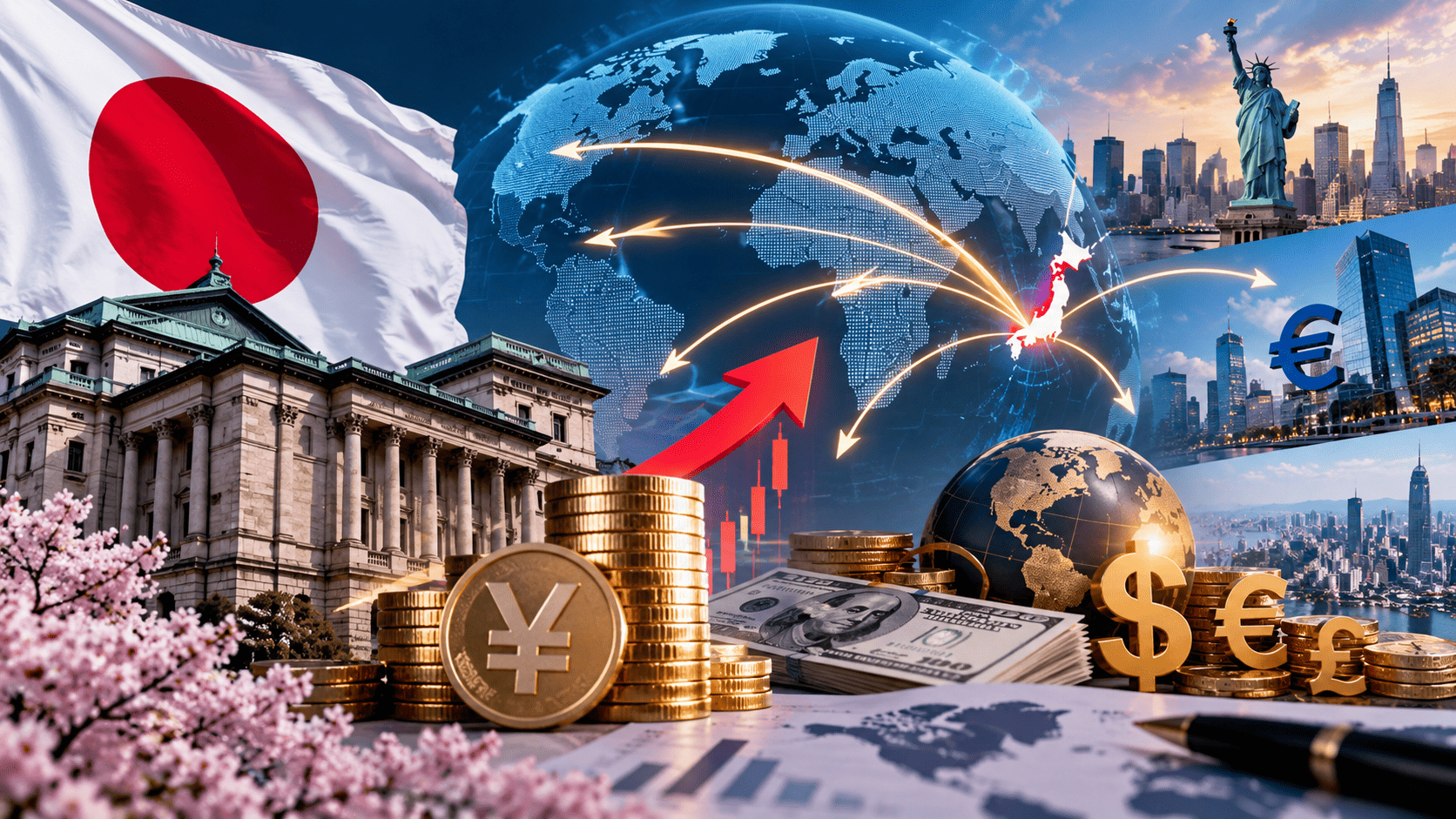
For decades, Japan was one of the world’s most important sources of cheap money. Extremely low interest rates encouraged investors to borrow Japanese yen and move that capital into higher-yielding assets around the world.
That financial landscape is changing rapidly in 2026.
On September 18, the Bank of Japan raised its policy rate from 1% to 1.25%, the highest level in about 31 years. The decision comes as Japan continues to deal with inflation, a weak yen and changing global economic conditions.
The increase may look small compared with interest rates in some other major economies, but its global significance is much larger.
Japan is a major international investor, and Japanese investors hold substantial amounts of overseas bonds and equities. Higher returns available inside Japan could gradually change the way this capital is allocated.
This raises an important question for global markets:
Could higher Japanese interest rates change where investors borrow, where they invest and where global money ultimately flows?
Table of Contents
- Why Is Japan Raising Interest Rates in 2026?
- What Is the Yen Carry Trade?
- Why Higher Japanese Rates Matter for Global Investors
- Could Japanese Money Move Back Home?
- How Could This Affect U.S. Treasury Bonds?
- What Happens to the Global Bond Market?
- What Could Happen to Emerging Markets?
- Why the Yen Carry Trade Is Being Watched Again
- Japan Could Change the Global Competition for Capital
- What Should Investors Watch Next?
- What Does This Mean for Global Markets in 2026?
- Final Thoughts: Japan’s Rate Shift Could Redefine Global Money Flows
Why Is Japan Raising Interest Rates in 2026?
The Bank of Japan spent decades operating with exceptionally low interest rates.
That environment was designed to support economic activity and fight persistent deflation. However, Japan’s economic conditions have changed.
Inflation has become more persistent, businesses have been passing higher costs to consumers, and wage conditions have improved compared with the country’s earlier low-inflation environment.
The BOJ’s September 2026 rate increase to 1.25% represents another step toward monetary-policy normalization. Reuters reported that the decision was made by a 7-2 vote, with two policymakers preferring a more cautious approach.
The move also matters for the yen.
When Japanese interest rates rise, the return investors can potentially earn from yen-denominated assets becomes more attractive. That can change the balance between holding money in Japan and investing overseas.
What Is the Yen Carry Trade?
The yen carry trade has been an important feature of global financial markets.
The basic strategy is relatively simple.
Investors borrow money in Japanese yen at comparatively low interest rates and then use that money to purchase assets offering higher potential returns elsewhere.
Those assets can include U.S. bonds, equities and emerging-market currencies.
Reuters describes the carry trade as borrowing yen at low cost and investing in higher-yielding currencies and assets.
The strategy works best when three conditions remain favorable:
- Japanese borrowing costs stay low.
- Overseas assets offer higher returns.
- The yen does not rise sharply against the currencies of those investments.
Higher Japanese rates can challenge the first condition.
A stronger yen can create another problem because investors may need more money to repay yen-denominated borrowing.
Why Higher Japanese Rates Matter for Global Investors
The significance of Japan extends beyond its domestic economy.
Japanese investors have accumulated large overseas portfolios over many years. Vanguard notes that Japanese investors hold significant amounts of overseas bonds and equities, while low Japanese interest rates helped make the yen an important funding currency for global carry trades.
If Japanese assets become more attractive, some investors may decide to keep more capital at home.
That does not mean Japanese investors will suddenly sell all their foreign investments.
Instead, the adjustment could happen gradually as new money is allocated differently, existing investments mature and investors compare domestic and overseas returns.
This creates a potentially important change in the global competition for capital.
Could Japanese Money Move Back Home?
Higher domestic yields can make Japanese government bonds and other Japanese assets more competitive with overseas investments.
Japan’s 10-year government bond yield reached around 3% in early September, a level not seen since 1996, according to Reuters.
Reuters also reported that Japan’s large overseas debt holdings mean even gradual changes in Japanese investment preferences can matter for global bond markets.
However, investors do not compare interest rates alone.
They also consider:
- Currency movements
- Inflation
- Credit risk
- Hedging costs
- Economic growth
- Expected returns
- Investment duration
Therefore, higher Japanese rates could encourage some capital to remain in Japan without automatically causing a massive global repatriation.
How Could This Affect U.S. Treasury Bonds?
The United States has historically benefited from strong international demand for Treasury securities.
Japan is one of the largest foreign holders of U.S. government debt.
If Japanese investors increasingly find domestic bonds attractive, demand for some overseas bonds could weaken at the margin.
Vanguard says rising Japanese domestic yields could potentially reduce an important source of demand for U.S. Treasuries and other global assets.
This matters because lower demand for bonds can contribute to higher yields when other factors are unchanged.
Higher Treasury yields can then affect borrowing costs across the economy.
Mortgage rates, corporate borrowing costs and financing conditions for businesses can all be influenced by movements in government bond yields.
What Happens to the Global Bond Market?
Japan’s changing interest-rate environment comes at a time when governments and companies around the world already need substantial amounts of capital.
Vanguard points to growing global competition for capital as governments face financing needs, technology companies fund AI investment and private markets absorb increasing amounts of debt supply.
If Japanese investors demand more domestic assets while governments and companies elsewhere continue issuing large amounts of debt, international borrowers may need to offer more attractive yields to compete for investor money.
This could keep pressure on global bond yields.
The effect would not necessarily be dramatic every day, but the direction of capital flows can become increasingly important over time.
Could Higher Japanese Rates Strengthen the Yen?
Higher interest rates can support a currency because they can improve the potential return on assets denominated in that currency.
The yen has already experienced significant volatility in 2026.
Reuters reported in early September that the yen had risen sharply as markets anticipated faster Bank of Japan tightening. The currency gained around 4.5% in one week at that point.
However, the relationship is not automatic.
Currency markets also respond to interest-rate differences between countries, economic expectations, energy prices, government policy and investor positioning.
Following the September rate decision, Reuters reported that the yen weakened because investors did not see sufficiently strong signals for a more aggressive tightening path.
That shows why investors must watch both the actual rate decision and the BOJ’s guidance about future policy.
What Could Happen to Emerging Markets?
Emerging markets could also feel the effects of changing Japanese capital flows.
Many investors use low-cost funding currencies to seek higher returns in emerging-market bonds, equities and currencies.
If the yen becomes more expensive to borrow or appreciates sharply, investors may reduce some of these positions.
That could create selling pressure in higher-risk assets.
Reuters has highlighted concerns about the potential effect of a changing yen carry trade on global markets.
However, the impact will depend on how quickly Japanese rates rise and how large the difference remains between Japanese and overseas yields.
Could Japanese Rate Hikes Affect Stock Markets?
Stock markets can also be affected indirectly.
When borrowing costs rise, investors generally pay greater attention to the return they expect from risky assets.
This can be particularly relevant for growth stocks whose valuations depend heavily on expected future earnings.
A stronger yen can also affect Japanese exporters because overseas revenues can translate into fewer yen when the currency appreciates.
At the same time, higher domestic rates could benefit Japanese financial institutions and savers.
Therefore, the impact of higher Japanese rates will differ across industries and countries.
Why the Yen Carry Trade Is Being Watched Again
The yen carry trade has returned to the center of market discussions because the assumptions supporting it are changing.
For years, investors could borrow yen at extremely low rates and invest elsewhere.
Now Japanese interest rates are moving higher, Japanese bond yields are rising and the yen has become more volatile.
Reuters reported that expectations of faster BOJ tightening were already undermining the traditional carry-trade strategy before the September meeting.
The key issue is not simply whether the carry trade disappears.
Instead, investors are watching whether positions are reduced gradually or whether currency movements force investors to unwind positions quickly.
A rapid unwind can create volatility because investors may sell the assets they purchased with borrowed yen and then buy yen to repay their funding.
Japan Could Change the Global Competition for Capital
One of the most important consequences of higher Japanese rates may be a change in the global competition for investor money.
For many years, investors could look outside Japan for higher yields because domestic returns were extremely low.
That equation is changing.
If Japanese government bonds and other domestic assets offer increasingly attractive returns, investors may have less incentive to take currency and overseas-market risk.
Vanguard describes this as increasing competition for global capital, with Japan playing an important role because of its large overseas investment position.
This does not mean global money will suddenly leave the United States, Europe or emerging markets.
Instead, the marginal flow of new investment could gradually become more balanced.
What Should Investors Watch Next?
The Bank of Japan’s policy rate is only one part of the story.
Investors should monitor several indicators during the remainder of 2026.
1. Japanese Government Bond Yields
Higher Japanese bond yields could make domestic fixed-income investments more attractive.
2. The Yen-Dollar Exchange Rate
A stronger or weaker yen can change the economics of currency-hedged and unhedged overseas investments.
3. BOJ Policy Guidance
Future rate-hike expectations could be just as important as the current policy rate.
4. U.S. Treasury Yields
Changes in Japanese demand for U.S. government debt could become one factor influencing Treasury markets.
5. Carry-Trade Positioning
Investors will watch whether yen-funded positions are being reduced or rebuilt.
6. Japanese Overseas Investment
Changes in Japanese purchases of foreign bonds and equities can provide clues about whether capital is gradually moving back toward domestic markets.
What Does This Mean for Global Markets in 2026?
Japan’s monetary-policy shift is happening at an important time.
Global governments need large amounts of financing. Technology companies are spending heavily on AI infrastructure. Bond markets are absorbing significant new debt supply. At the same time, investors are reassessing interest rates and inflation.
Against this backdrop, Japan’s return toward higher interest rates could become another important source of pressure on global capital markets.
The impact will depend on the speed of future BOJ hikes, the yen’s direction, Japanese investor behavior and interest-rate differences between Japan and other major economies.
Final Thoughts: Japan’s Rate Shift Could Redefine Global Money Flows
Japan’s higher interest rates are more than a domestic monetary-policy story.
They could influence where global investors borrow money, where they seek returns and how much capital remains invested overseas.
The September 2026 BOJ rate increase to 1.25% marks another significant step away from Japan’s decades-long era of ultra-low rates.
For global investors, the key issue is not simply the next Japanese rate hike.
It is the broader change in the international flow of capital.
If Japanese domestic yields continue rising, the yen strengthens and the carry trade becomes less attractive, global investors may need to rethink strategies that depended on extremely cheap Japanese funding.
That could make Japan an increasingly important market to watch for anyone following global bonds, currencies, stocks and international investment flows in 2026.

References


