
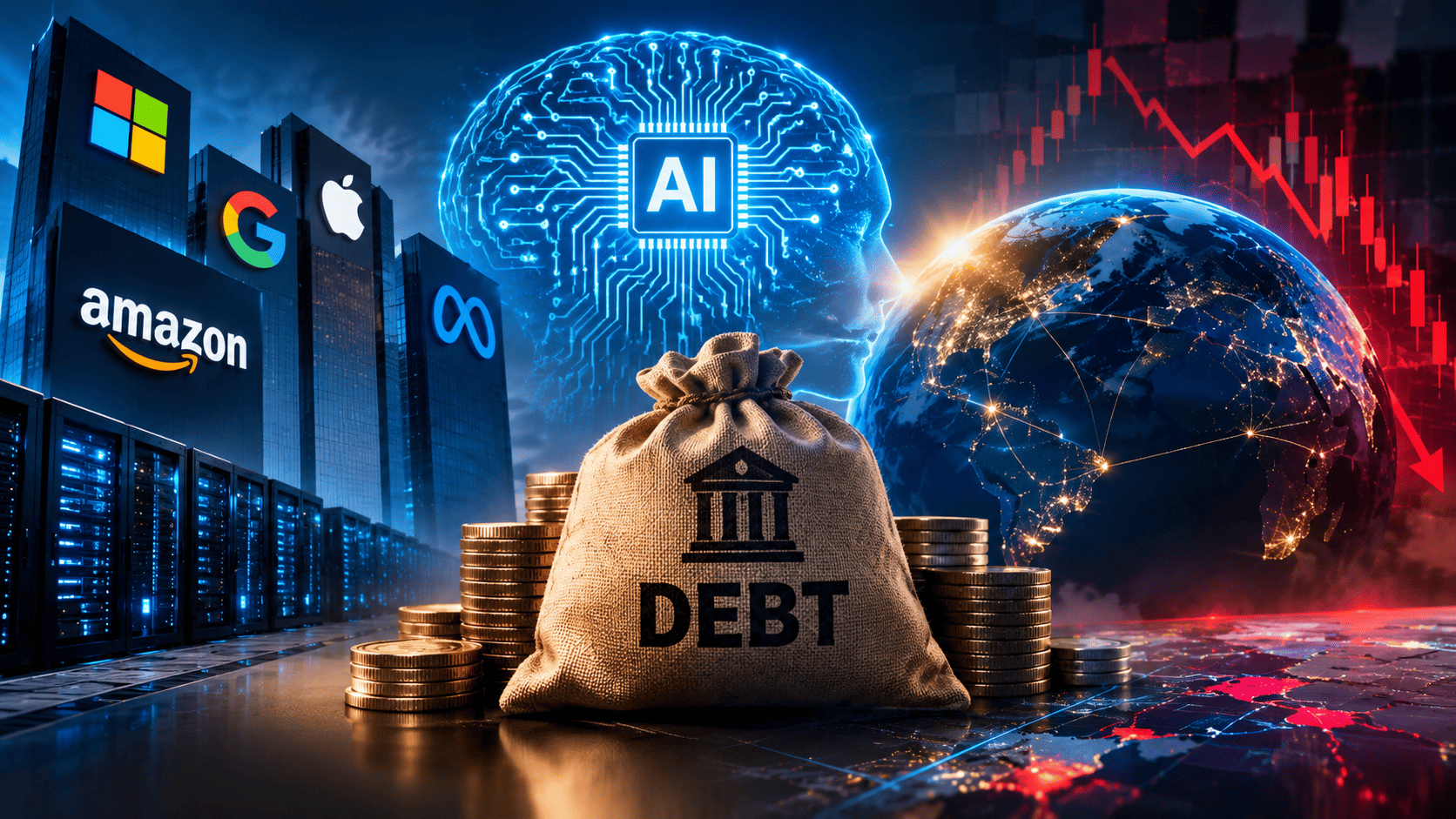
Artificial intelligence has become one of the biggest investment stories in global markets. Technology companies are spending enormous amounts of money on AI chips, data centers, cloud infrastructure and computing capacity. But in 2026, a new financial question is becoming increasingly important: How much of the AI boom is being financed with debt?
Major technology companies are turning increasingly to bond markets and other forms of external financing as AI infrastructure spending grows. Recent analysis from S&P Global Ratings says AI infrastructure investment could exceed $1.3 trillion by 2027, highlighting the enormous amount of capital required to expand the global AI ecosystem.
At the same time, Reuters reported in September 2026 that major hyperscalers including Alphabet, Amazon, Meta, Microsoft and Oracle had issued approximately $220 billion of bonds over the previous year to help finance data-center expansion.
This creates an important question for investors: Could rising AI-related corporate debt eventually become a broader global market risk?
Table of Contents
- Why Is Big Tech Borrowing So Much for AI?
- How Big Is the AI Debt Wave in 2026?
- Why Rising Interest Rates Make AI Debt More Important
- What Happens If AI Profits Do Not Keep Up?
- The Hidden Risk: AI Financing Beyond Corporate Bonds
- Could AI Debt Become a Global Market Risk?
- Why Investors Are Watching AI Spending and Debt Together
- What Could Happen Next?
- What Should Investors Watch in 2026?
- Final Thoughts: The AI Boom Has Entered a New Financial Phase
Why Is Big Tech Borrowing So Much for AI?
The AI race requires enormous physical infrastructure.
Companies need advanced GPUs, servers, electricity, cooling systems, networking equipment and massive data centers. Building this infrastructure requires billions of dollars before companies can fully determine how quickly those investments will generate profits.
Historically, some of the largest technology companies were able to fund major investments largely through their own cash flows. The scale of the current AI infrastructure cycle is changing that equation.
FactSet has noted that hyperscalers are increasingly using external financing as AI capital expenditure grows faster than available cash flow.
Debt therefore becomes another source of capital.
Companies can issue bonds, borrow through credit markets or use financing structures connected to data-center projects. These approaches allow companies to continue investing in AI without relying entirely on current operating cash flow.
How Big Is the AI Debt Wave in 2026?
The exact size depends on what is counted as AI-related borrowing.
Direct corporate bond issuance is only one part of the picture. Financing can also occur through private credit, infrastructure partnerships, leases and special-purpose vehicles.
Reuters reported that the major hyperscalers had issued about $220 billion in bonds over the previous year, showing how significant technology companies have become in the investment-grade credit market.
Another recent report citing Bank of America Global estimates that major technology companies could issue around $330 billion of bonds during 2026.
These figures do not mean that all of this borrowing represents financial distress. Large technology companies still have substantial businesses, revenues and cash flows.
The bigger issue is the speed and scale of new borrowing.
Why Rising Interest Rates Make AI Debt More Important
Debt becomes more expensive when interest rates and bond yields rise.
This matters because AI infrastructure projects are extremely capital-intensive and often have long payback periods. If financing costs increase, companies may need higher future profits to justify the same investments.
Recent market developments have made this issue more visible.
Reuters reported on September 16, 2026, that rising bond yields were being driven partly by strong economic activity and increased capital expenditure, particularly investment by major technology companies.
For investors, the connection is straightforward:
More AI investment → more financing needs → more bond issuance → greater sensitivity to borrowing costs.
If interest rates remain elevated, the cost of funding the AI expansion could become a more important factor in corporate profitability.
Could AI Debt Put Pressure on the Bond Market?
One of the biggest concerns is not simply whether individual technology companies can repay their debt.
It is whether a large wave of technology-company borrowing could affect the wider credit market.
Reuters recently reported that the rapid increase in AI-related corporate bond issuance is disrupting traditional credit-market pricing. The report estimated approximately $220 billion of bonds issued by major hyperscalers over the previous year.
When several large companies issue significant amounts of debt at the same time, investors must absorb a much larger supply of corporate bonds.
That can influence the relative attractiveness and pricing of other assets, including U.S. Treasury securities.
Some analysts have described this as a potential “crowding” effect in bond markets, although the precise impact depends on investor demand, interest rates and broader economic conditions.
What Happens If AI Profits Do Not Keep Up?
This is perhaps the most important financial question behind the AI investment boom.
Companies are spending heavily today based on expectations about future AI demand.
That investment could eventually generate substantial revenue through cloud services, AI software, advertising, enterprise applications and other businesses.
But if monetization takes longer than expected, companies could face pressure from several directions at once.
They could have:
- Higher interest expenses
- Large depreciation costs
- Expensive data-center commitments
- Slower-than-expected AI revenue
- Pressure on free cash flow
- Greater investor scrutiny of capital spending
This does not mean a debt crisis is inevitable.
S&P Global has highlighted growing credit-quality concerns around the rapid expansion of AI infrastructure financing, while also noting that major hyperscalers have strong financial positions compared with more speculative borrowers.
The risk is therefore better understood as a scenario to monitor, rather than evidence that Big Tech is already facing a systemic debt crisis.
The Hidden Risk: AI Financing Beyond Corporate Bonds
Another important part of the story is that not every dollar supporting AI infrastructure appears as straightforward corporate debt on a technology company’s balance sheet.
Companies can use partnerships, leasing arrangements, infrastructure funds and special-purpose entities to finance data centers.
These structures can distribute financial risk among technology companies, infrastructure providers, banks, private-credit investors and asset managers.
That creates a more interconnected financial system.
If AI investment continues generating strong returns, this structure could support further growth.
But if AI demand or asset values weaken sharply, investors may begin paying closer attention to who ultimately carries the financial risk.
Could AI Debt Become a Global Market Risk?
There are several channels through which AI-related borrowing could affect global markets.
1. Higher Corporate Borrowing Costs
If investors demand higher yields from technology companies, future AI infrastructure projects could become more expensive to finance.
2. Pressure on Bond Markets
A large supply of technology bonds could affect credit spreads and the relative pricing of corporate and government debt.
3. Lower Corporate Cash Flow
Higher interest expenses combined with massive capital expenditure could reduce free cash flow.
4. Technology Stock Valuations
If investors begin focusing more heavily on debt, financing costs and returns on AI investment, technology-stock valuations could become more sensitive to changes in interest rates.
5. Global Spillovers
The AI infrastructure ecosystem is international. It involves semiconductor companies, cloud providers, data-center operators, utilities, banks, private-credit funds and investors around the world.
A major slowdown in AI investment could therefore affect multiple industries simultaneously.
Why Investors Are Watching AI Spending and Debt Together
For several years, investors primarily focused on AI revenue growth and technology-stock valuations.
In 2026, the financial discussion is expanding.
Investors are increasingly looking at capital expenditure, free cash flow, bond issuance, credit spreads and interest costs alongside AI revenue.
That shift is important because a company’s AI strategy is not only a technology decision.
It is also a capital-allocation decision.
The more money a company commits to AI infrastructure, the more important it becomes to understand how that investment is funded and how quickly it can generate returns.
Is the AI Boom Becoming a Debt-Fueled Bubble?
The answer is not yet clear.
There are genuine economic reasons for enormous AI infrastructure investment. Companies need computing capacity to provide AI services, and global demand for data-center infrastructure continues to grow.
At the same time, the rapid growth in borrowing has created new questions about valuation, financing costs and future returns.
Recent market reporting shows that AI-related debt issuance has become large enough to influence the broader credit market.
That does not automatically make the AI boom a bubble.
Instead, it means investors have another variable to monitor: the relationship between AI spending, debt and future cash flows.
What Could Happen Next?
Three broad scenarios are possible.
Scenario 1: AI Revenue Catches Up
If AI services generate strong and sustainable revenue, companies could use those cash flows to support their infrastructure investments and manage their debt.
Scenario 2: AI Investment Continues but Returns Take Longer
Companies could maintain high spending while carrying greater financing costs for several years. Markets could become more selective about which AI projects deserve additional capital.
Scenario 3: AI Demand Falls Sharply
A significant slowdown in AI demand could leave companies with expensive infrastructure commitments and less revenue growth than expected.
In that environment, investors could reassess technology valuations, corporate bonds and infrastructure investments simultaneously.
These scenarios illustrate why the AI debt story is becoming increasingly relevant to global markets.
What Should Investors Watch in 2026?
Investors following the AI debt story should watch several indicators:
AI capital expenditure: Are technology companies continuing to increase infrastructure spending?
Corporate bond issuance: How much new debt are major technology companies bringing to the market?
Free cash flow: Is operating cash flow keeping pace with capital expenditure?
Interest rates: Are higher Treasury yields increasing corporate financing costs?
Credit spreads: Are investors demanding additional compensation for technology-company debt?
AI revenue growth: Are AI products generating enough revenue to justify infrastructure investment?
Data-center demand: Are companies actually using the computing capacity they are building?
Together, these indicators can provide a clearer picture of whether the AI investment cycle is becoming financially more sustainable or more dependent on external financing.
Final Thoughts: The AI Boom Has Entered a New Financial Phase
The AI revolution is no longer only a technology story.
It has become a major capital-markets story.
Billions of dollars are being invested in data centers, chips, electricity and cloud infrastructure, while debt markets are increasingly helping finance that expansion. S&P Global expects AI infrastructure investment to exceed $1.3 trillion by 2027, while recent reporting shows major hyperscalers have already become significant issuers in the corporate bond market.
The key question for 2026 and beyond is not simply how much companies spend on AI.
It is whether the future cash flows generated by AI will be large enough to justify the enormous amount of capital being committed today.
If AI revenues and productivity gains keep expanding, today’s borrowing could support one of the largest technology investment cycles in history.
If returns disappoint while borrowing costs remain high, however, AI-related debt could become an increasingly important source of pressure across technology stocks, corporate credit and global financial markets.
For investors, the AI boom is therefore entering a phase where debt, cash flow and returns on investment may matter just as much as AI growth itself.

References


