
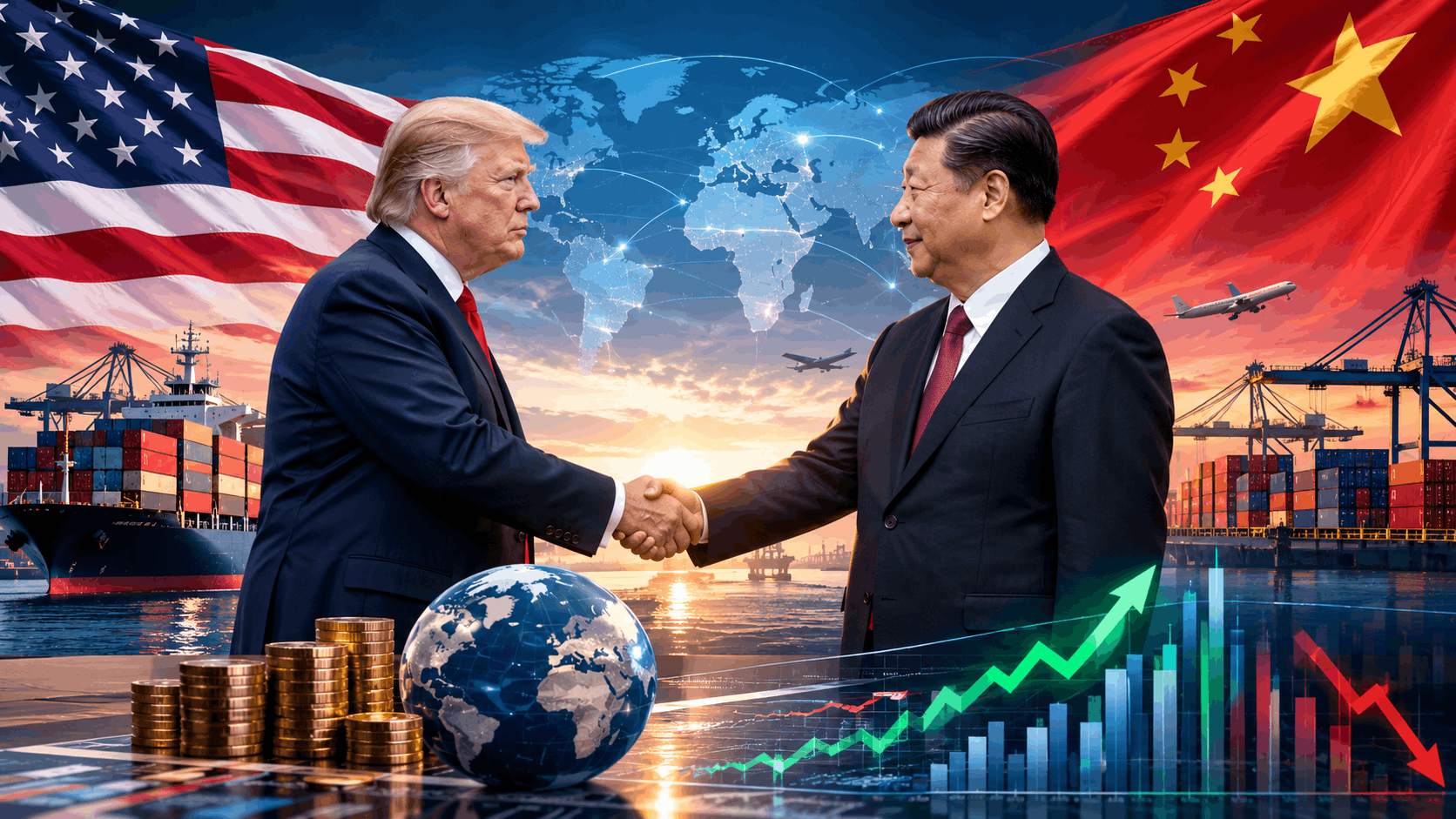
The world’s two largest economies are preparing for another high-stakes meeting that could influence global trade, supply chains and financial markets.
U.S. President Donald Trump is scheduled to meet Chinese President Xi Jinping in Washington on September 24, 2026, for their second summit of the year. The meeting comes as Washington and Beijing continue negotiating over tariffs, technology, rare earths, agriculture and energy.
Markets are watching closely because even a limited agreement could affect the cost of imported goods, corporate supply chains, commodity demand and investor expectations.
Recent negotiations have included discussions about reducing tariffs on selected goods, while the two countries are also discussing potential changes involving U.S. liquefied natural gas exports and agricultural products. Reuters reports that one proposal under discussion could involve each country reducing tariffs on roughly $30 billion of goods, although the discussions were not final as of September 18.
So what could a new Trump-Xi trade arrangement mean for the global economy?
Table of Contents
- Why Is the Trump-Xi Summit Important for Global Markets?
- Could the U.S. and China Cut Tariffs?
- What Could Happen to U.S. Companies?
- Could China Buy More U.S. Energy?
- Why Are Rare Earths So Important?
- What Could a Trump-Xi Deal Mean for Technology Stocks?
- How Could Global Stock Markets React?
- Could the U.S. Dollar and Chinese Yuan Be Affected?
- Could Emerging Markets Benefit?
- What Are Investors Watching Before September 24?
- What Could Happen After the Trump-Xi Summit?
- Why the Details Could Matter More Than the Headlines
- Final Thoughts: Could Trump-Xi Talks Reshape Global Markets?
Why Is the Trump-Xi Summit Important for Global Markets?
The United States and China are deeply connected through trade, manufacturing, technology and investment.
Changes in tariffs between the two countries can affect companies far beyond their borders because many global supply chains depend on Chinese manufacturing and U.S. consumers.
The September summit is particularly important because the current trade truce is approaching its November expiration. Analysts and policymakers are therefore watching whether Washington and Beijing can extend the existing framework or negotiate additional commitments.
For financial markets, the key issue is not simply whether Trump and Xi reach an agreement.
Investors will also examine what is included, how long the commitments last and whether both governments implement them.
Could the U.S. and China Cut Tariffs?
Tariffs are expected to be one of the central economic issues at the summit.
China has publicly expressed hope that the two countries can reach an agreement to reduce import taxes, while U.S. and Chinese negotiators have been discussing possible tariff reductions ahead of the meeting.
One proposal reportedly under discussion involves tariff reductions covering around $30 billion of goods on each side.
If implemented, lower tariffs could reduce costs for businesses importing affected products.
However, the economic impact would depend heavily on which products receive tariff relief.
A broad reduction would have a different effect from a narrowly targeted agreement covering selected non-sensitive goods.
How Could a Trade Deal Affect Inflation?
Tariffs increase the cost of imported goods when companies pass some or all of the additional expense through supply chains.
A reduction in tariffs could therefore lower costs for some importers.
Businesses could potentially benefit from cheaper components, raw materials and finished products.
Consumers could also see lower prices in some categories if companies pass those savings through to retail markets.
However, tariffs are only one factor influencing inflation.
Energy prices, wages, transportation costs, exchange rates and global commodity prices would continue to play important roles.
Therefore, a Trump-Xi trade agreement could affect inflation at the margin without automatically changing the overall inflation trend.
What Could Happen to U.S. Companies?
American companies with significant exposure to Chinese manufacturing or the Chinese consumer market could be particularly sensitive to the outcome.
Lower tariffs could reduce costs for businesses importing products from China.
Companies involved in agriculture, energy, manufacturing, transportation and technology could also be affected depending on the final agreements.
The U.S. government is also seeking greater market access for American farmers and manufacturers. The U.S. Trade Representative said the administration intends to pursue balanced trade, improve market access and monitor implementation of recent commitments.
For investors, this means the summit could create different effects across industries rather than producing one uniform market reaction.
Could China Buy More U.S. Energy?
Energy trade is another major area to watch.
Reuters reported on September 18 that the United States and China were discussing a possible reduction or elimination of Chinese tariffs on American liquefied natural gas as part of a broader potential package involving energy and agriculture.
China imposed a 15% tariff on U.S. LNG in 2025, which significantly reduced LNG trade between the two countries.
If those tariffs were reduced, American LNG producers could potentially regain access to an important international market.
That could affect:
- U.S. LNG exporters
- Natural gas demand
- Global energy trade
- Shipping markets
- Asian energy buyers
- European energy competition
The actual market impact would depend on whether the discussions turn into a formal agreement.
Why Are Rare Earths So Important?
Rare earth minerals have become one of the most important economic issues in U.S.-China relations.
These materials are essential for many advanced technologies, electronics, electric vehicles, renewable-energy equipment and defense applications.
China plays a major role in global rare-earth supply chains, making export controls a significant concern for manufacturers.
Current U.S.-China discussions include rare earths and critical minerals, with American officials seeking greater predictability in supply chains. U.S. Treasury Secretary Scott Bessent is also scheduled to discuss rare earths and AI with Chinese Vice Premier He Lifeng ahead of the summit.
Any agreement affecting rare-earth exports could therefore have implications well beyond the United States and China.
What Could a Trump-Xi Deal Mean for Technology Stocks?
Technology is another major point of tension.
The United States and China are competing in areas including artificial intelligence, semiconductors and advanced computing.
At the same time, companies around the world depend on international technology supply chains.
The World Economic Forum identifies technology, critical minerals and trade as important issues expected to feature in the September 24 meeting.
A deal that reduces uncertainty around technology trade could improve sentiment toward some technology and semiconductor companies.
On the other hand, continued restrictions on advanced technology exports could maintain pressure on companies that depend heavily on cross-border semiconductor supply chains.
Could the Trade Deal Strengthen Global Supply Chains?
Businesses have spent years adjusting their supply chains because of U.S.-China trade tensions.
Some companies have expanded manufacturing in countries such as Vietnam, Mexico and other Asian economies.
A more stable U.S.-China trade relationship could change some of those calculations.
Companies may become more comfortable maintaining parts of their existing supply chains if tariff risks decline.
However, businesses are unlikely to abandon diversification strategies immediately.
After years of trade restrictions and geopolitical uncertainty, companies may continue using multiple manufacturing locations to reduce their exposure to any single country.
How Could Global Stock Markets React?
Financial markets typically respond to changes in expectations.
If investors believe the summit will reduce trade tensions, markets could react positively to sectors exposed to international trade.
Potentially affected areas include:
Semiconductors: Changes in technology restrictions could influence chip companies and equipment suppliers.
Agriculture: Increased Chinese purchases could affect U.S. agricultural exporters.
Energy: Lower tariffs on American LNG could support cross-border energy trade.
Manufacturing: Lower tariffs could reduce some input costs.
Transportation: Greater trade volumes could affect shipping and logistics companies.
However, market reactions can change quickly if negotiations produce fewer concessions than investors expected.
Could the U.S. Dollar and Chinese Yuan Be Affected?
Currency markets could also respond to the summit.
A more stable trade relationship could reduce some uncertainty surrounding the U.S.-China economic relationship.
The Chinese yuan could respond to changes in trade expectations, export conditions and capital flows.
The U.S. dollar could also react indirectly through changes in global risk sentiment and expectations for U.S. economic growth.
Currency movements would not depend on the summit alone, however.
Interest rates, inflation, central-bank policy and broader economic conditions remain major drivers of exchange rates.
What Does the Summit Mean for Global Inflation?
One of the most important questions for investors is whether lower trade barriers could reduce global cost pressures.
A sustained reduction in tariffs could make certain imported goods and components cheaper.
It could also reduce uncertainty for companies planning long-term investments.
But global inflation is influenced by many factors.
Energy markets, wages, shipping costs, currency movements and monetary policy could all offset or amplify the effects of a trade agreement.
Therefore, investors should view tariff reductions as one potential influence rather than a guaranteed path toward lower global inflation.
Could Emerging Markets Benefit?
Emerging markets could experience both opportunities and challenges.
If U.S.-China trade relations improve, global trade volumes could become more predictable.
Countries integrated into Asian manufacturing networks could benefit from stronger demand.
However, a U.S.-China agreement could also reduce the incentive for companies to move production into alternative manufacturing hubs.
Countries that benefited from supply-chain diversification could therefore face a different competitive environment if some businesses become more comfortable relying on China again.
The final outcome would depend on the scope and durability of the agreement.
What Are Investors Watching Before September 24?
Investors are focusing on several specific issues ahead of the summit.
1. Tariff Reductions
Markets will watch whether the two sides announce concrete tariff cuts and which products are covered.
2. Rare-Earth Exports
Any agreement involving critical minerals could affect technology and manufacturing supply chains.
3. U.S. LNG
A reduction in Chinese tariffs on American LNG could reopen an important energy-trade channel.
4. Agricultural Purchases
Investors will watch for commitments involving U.S. agricultural exports, particularly products important to American farmers.
5. Semiconductor and AI Restrictions
Technology remains one of the most difficult areas of the relationship, with both countries competing over advanced AI and semiconductor capabilities.
6. Trade-Truce Extension
The current framework is approaching its November expiration, making the duration of any new arrangement particularly important for businesses.
What Could Happen After the Trump-Xi Summit?
Several outcomes are possible.
A Limited Trade Agreement
The two countries could announce targeted tariff reductions and commitments involving agriculture, energy or other selected products.
Extension of the Existing Truce
Washington and Beijing could focus on extending the current period of relative trade stability without resolving all major disagreements.
Broader Economic Agreement
A wider package could address tariffs, critical minerals, energy and technology.
Limited Progress
The summit could produce diplomatic engagement without significant changes to existing trade restrictions.
These possibilities are why investors are focusing on the details of the agreement rather than simply the meeting itself.
Why the Details Could Matter More Than the Headlines
Financial markets can react strongly to expectations before an agreement is officially signed.
If investors have already priced in substantial tariff relief, a smaller agreement could produce a very different market reaction than expected.
Conversely, unexpected progress on areas such as rare earths, LNG or agricultural trade could influence specific industries.
The World Economic Forum has characterized the upcoming summit as an effort to stabilize a fragile trade détente rather than necessarily deliver a complete reset in U.S.-China economic relations.
That distinction is important for investors.
A temporary reduction in trade tensions is different from a permanent resolution of the broader economic relationship.
Final Thoughts: Could Trump-Xi Talks Reshape Global Markets?
The September 24, 2026 Trump-Xi summit arrives at a critical moment for global trade.
The United States and China are discussing tariffs, energy, agriculture, rare earths and technology while businesses continue adapting to a changing global supply chain.
A new trade agreement could reduce uncertainty for some businesses, improve access to certain markets and influence commodity and financial markets.
But the long-term impact will depend on the scope, duration and implementation of any agreement.
For investors, the key signals to watch are tariff reductions, rare-earth export policies, LNG trade, agricultural purchases, technology restrictions and the future of the existing trade truce.
The Trump-Xi summit may therefore be more than a diplomatic meeting. It could become an important market event for global trade, technology, energy, commodities and international investment flows in late 2026.

References


