
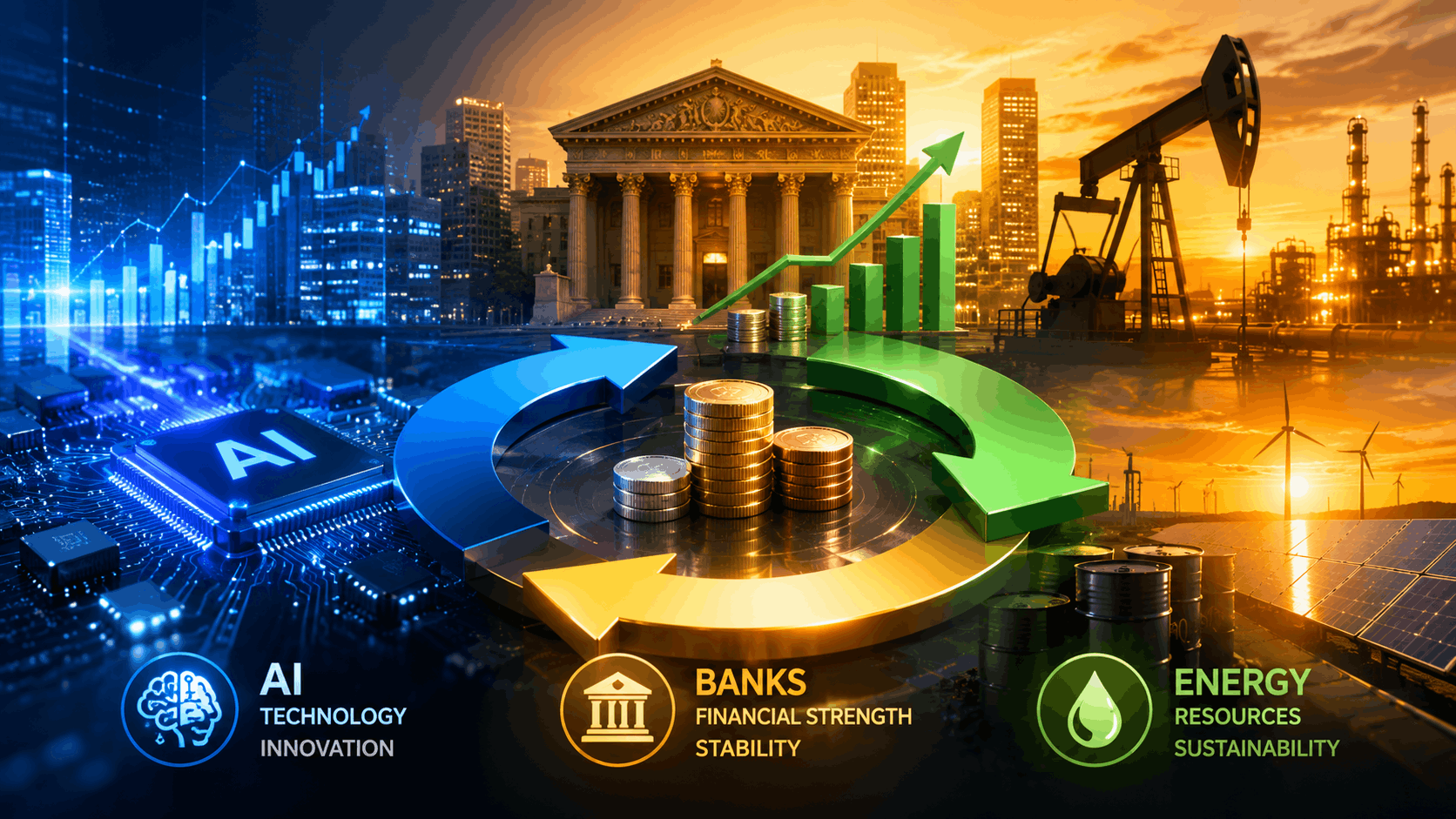
The stock market in 2026 is becoming increasingly focused on sector rotation rather than simply buying the biggest technology names. Investors are reassessing where earnings growth, cash flow and economic resilience could be strongest as interest rates, inflation, AI investment and geopolitical risks continue to influence markets.
Artificial intelligence remains a major investment theme, but concerns about high valuations and massive infrastructure spending have encouraged investors to look beyond semiconductor and hardware companies. At the same time, banks can benefit from higher yields and stronger financial conditions, while energy stocks are receiving support from elevated oil prices and geopolitical uncertainty.
Recent market movements show this shift clearly. AI-related stocks have faced periods of sharp selling, while energy and other defensive or value-oriented sectors have demonstrated relative strength.
Table of Contents
What Is Driving Sector Rotation in 2026?
Sector rotation occurs when investors move capital from one group of stocks to another based on changing economic expectations, valuations, interest rates or market risks.
In 2026, several forces are contributing to this movement:
- AI valuations and spending concerns
- Rising Treasury yields
- Changing Federal Reserve expectations
- Higher energy prices
- Geopolitical uncertainty
- Different earnings expectations across sectors
- Demand for broader portfolio diversification
This does not necessarily mean investors are abandoning AI. Instead, many investors are becoming more selective about where within the AI ecosystem they want exposure.
HSBC Private Bank has described a rotation from semiconductor and hardware stocks toward hyperscalers and software, while also highlighting opportunities across Energy, Materials, Communications and Financials.
Why Are Investors Still Buying AI Stocks?
Artificial intelligence remains one of the strongest structural investment themes in global markets.
Companies involved in chips, cloud computing, data centers, software and AI infrastructure continue to attract capital because businesses are increasing spending on AI capabilities.
Recent earnings from major technology companies have helped reduce some concerns about whether enormous AI infrastructure investments can eventually generate sufficient returns. Strong cloud growth and continuing capacity constraints have also supported investor confidence in the broader AI ecosystem.
However, investors are increasingly asking an important question:
How much AI spending can companies justify before the returns become difficult to measure?
That question is encouraging investors to differentiate between companies with strong cash flows and those that depend heavily on continued market enthusiasm.
Is the AI Investment Trade Becoming More Selective?
Yes. The AI investment story is becoming broader and more selective.
Earlier phases of the rally concentrated heavily on semiconductor and AI hardware companies. In 2026, investors are increasingly looking at the entire AI value chain.
This includes:
- Semiconductor manufacturers
- Cloud platforms
- AI software companies
- Data-center operators
- Power infrastructure
- Utilities
- Energy producers
- Networking companies
The shift is important because AI requires enormous amounts of electricity and physical infrastructure. As a result, the investment opportunity may extend beyond traditional technology companies.
Recent analysis has highlighted the growing importance of energy infrastructure because data centers require reliable and increasingly large electricity supplies.
Why Are Investors Looking at Bank Stocks?
Banks are attracting attention because their earnings are closely connected to interest rates, credit demand, loan growth and economic activity.
Higher interest rates can create both advantages and disadvantages for banks. While higher funding costs can pressure some businesses, banks may benefit from wider lending margins depending on the structure of their deposits and loans.
Banks can also offer investors exposure to economic growth without paying the same valuation premiums associated with some AI stocks.
This makes financial stocks particularly interesting when investors believe economic growth will remain resilient while expensive growth stocks face valuation pressure.
The broader financial sector is also benefiting from a market environment in which investors are increasingly searching for earnings outside mega-cap technology.
How Do Treasury Yields Affect Bank Stocks?
Treasury yields are an important factor for financial stocks.
When yields rise, banks and other financial institutions can potentially benefit from higher returns on certain assets. However, rapidly rising yields can also increase borrowing costs and create pressure on loan demand.
In August 2026, the 10-year Treasury yield has been trading around elevated levels, while the 30-year yield has also climbed sharply. This has created a complicated environment for both growth stocks and financial companies.
Therefore, investors are watching not only the level of yields but also why yields are rising.
Why Are Energy Stocks Attracting Investors?
Energy stocks have gained attention because oil and gas prices have remained elevated amid geopolitical uncertainty.
When crude oil prices rise, companies involved in exploration, production, refining and energy infrastructure can benefit from stronger commodity pricing.
Recent market developments have demonstrated this relationship. Oil prices moved higher as geopolitical tensions increased, supporting parts of the energy sector even while technology stocks faced pressure.
Energy can therefore provide investors with exposure to a completely different economic driver than AI.
Instead of depending primarily on technology spending, energy companies are influenced by commodity prices, global supply, demand and geopolitical developments.
How AI Is Creating Opportunities for Energy Companies
One of the most interesting developments in 2026 is the growing connection between AI and energy.
AI data centers consume significant amounts of electricity. As hyperscalers expand computing capacity, the demand for reliable power infrastructure is increasing.
This creates potential opportunities for:
- Natural gas producers
- Power generators
- Grid infrastructure companies
- Utilities
- Energy infrastructure businesses
- Renewable-energy providers
- Nuclear-energy companies
In other words, investors do not necessarily have to choose between AI and energy.
They can invest in companies that provide the power and infrastructure required to support the AI economy.
Recent investment commentary has specifically pointed to energy infrastructure as a potential beneficiary of expanding data-center electricity demand.
AI vs Banks vs Energy: Where Is the Opportunity?
Each sector offers a different investment profile.
AI Stocks
AI companies offer potentially high earnings growth but can also carry elevated valuations and expectations.
Bank Stocks
Banks can provide exposure to economic growth, credit expansion and financial-sector earnings, although they remain sensitive to interest rates and credit risks.
Energy Stocks
Energy companies can benefit from higher commodity prices and geopolitical disruptions, but their earnings can fluctuate significantly with oil and gas prices.
Therefore, the best-performing sector can change as the economic environment changes.
What Is Causing Investors to Reduce AI Concentration?
One reason is valuation.
When a small group of technology companies becomes responsible for a large portion of index gains, investors may become concerned about concentration risk.
Recent market commentary has highlighted growing concerns about AI-driven stock momentum and the possibility that valuations have moved faster than traditional measures of fundamentals.
Higher Treasury yields can also put pressure on high-growth companies because future earnings become less valuable when discounted at higher rates.
This does not necessarily invalidate the AI investment thesis. Instead, it can encourage investors to diversify across sectors and choose companies with stronger fundamentals.
What Role Does the Federal Reserve Play?
Federal Reserve policy remains one of the biggest drivers of sector performance.
If interest rates decline, high-growth technology companies could benefit because lower discount rates generally support higher valuations.
However, banks may respond differently depending on the pace of rate changes and the impact on lending margins.
Energy stocks are less directly tied to Fed policy and can instead be driven more strongly by oil prices and global supply conditions.
This creates an important distinction for investors.
One Fed decision can affect AI, banks and energy stocks in very different ways.
Why Sector Diversification Matters in 2026
The current market environment demonstrates why investors may not want their portfolios concentrated in one investment theme.
AI may continue to generate significant long-term growth, but banks can provide financial-sector exposure while energy can provide commodity and inflation sensitivity.
A diversified approach can potentially reduce dependence on one economic outcome.
For example, if AI valuations decline but oil prices remain strong, energy stocks may provide relative resilience. If economic growth improves and credit demand increases, banks could benefit. If AI earnings accelerate again, technology stocks could regain leadership.
The objective is not necessarily to predict the winning sector every month.
Instead, investors can focus on building exposure to several long-term drivers.
What Risks Should Investors Watch?
Despite the opportunities, all three sectors face meaningful risks.
AI Risks
AI companies face valuation concerns, intense competition, huge capital requirements and uncertainty about the speed of monetization.
Banking Risks
Banks remain exposed to credit losses, loan demand, funding costs and changes in interest-rate conditions.
Energy Risks
Energy companies face commodity-price volatility, geopolitical changes, regulation and shifts in global energy demand.
Investors should therefore evaluate company-specific fundamentals rather than assuming an entire sector will outperform.
What Should Investors Watch for the Rest of 2026?
Several indicators could determine whether the current sector rotation continues.
AI earnings: Investors will want evidence that AI spending is producing sustainable revenue and cash flow.
Treasury yields: Higher yields could continue to pressure expensive growth stocks.
Fed policy: Changes in rate expectations could quickly alter sector leadership.
Oil prices: Continued geopolitical risk could support energy stocks.
Bank earnings: Loan growth, credit quality and net interest margins will remain important.
Corporate capital spending: AI infrastructure spending will reveal whether the current investment boom can continue.
Economic growth: A stronger economy could benefit financials and cyclical sectors, while a slowdown could shift investors toward defensive assets.
Future Outlook for AI, Banks and Energy Stocks
The remainder of 2026 could bring continued competition between growth, value and commodity-linked sectors.
AI is unlikely to disappear as an investment theme. The technology’s long-term potential remains significant, and institutional investors continue to see opportunities across the AI ecosystem.
However, investors may become increasingly selective.
Banks could benefit if economic activity remains stable and financial conditions support lending. Energy could remain attractive if oil prices stay elevated because of supply constraints and geopolitical uncertainty.
The result could be a market where sector leadership changes more frequently instead of remaining concentrated in one group of technology stocks.
Why Sector Rotation Matters in Business and Finance
The rotation between AI, banks and energy stocks reflects a broader change in how investors are thinking about the economy.
AI represents technological growth and productivity.
Banks represent credit, financial activity and economic expansion.
Energy represents commodities, infrastructure and global supply security.
Together, these sectors provide a useful picture of the major forces shaping financial markets in 2026.
For investors, the key lesson is that market leadership can change when interest rates, valuations, commodity prices and economic expectations change.
The rotation between AI, banks and energy stocks is becoming one of the important investment themes of 2026.
AI remains a powerful long-term growth story, but concerns about valuations and massive capital spending are encouraging investors to look across the broader market. Banks offer exposure to financial activity and interest-rate conditions, while energy stocks can benefit from higher oil prices and geopolitical uncertainty.
The current environment does not necessarily indicate that investors are abandoning AI. Instead, capital appears to be spreading across different parts of the economy as investors search for growth, cash flow, valuation support and diversification.
For the rest of 2026, investors should watch AI earnings, Treasury yields, Federal Reserve policy, bank profitability, oil prices and geopolitical developments. These factors could determine which sectors lead the next stage of the market.

References


