
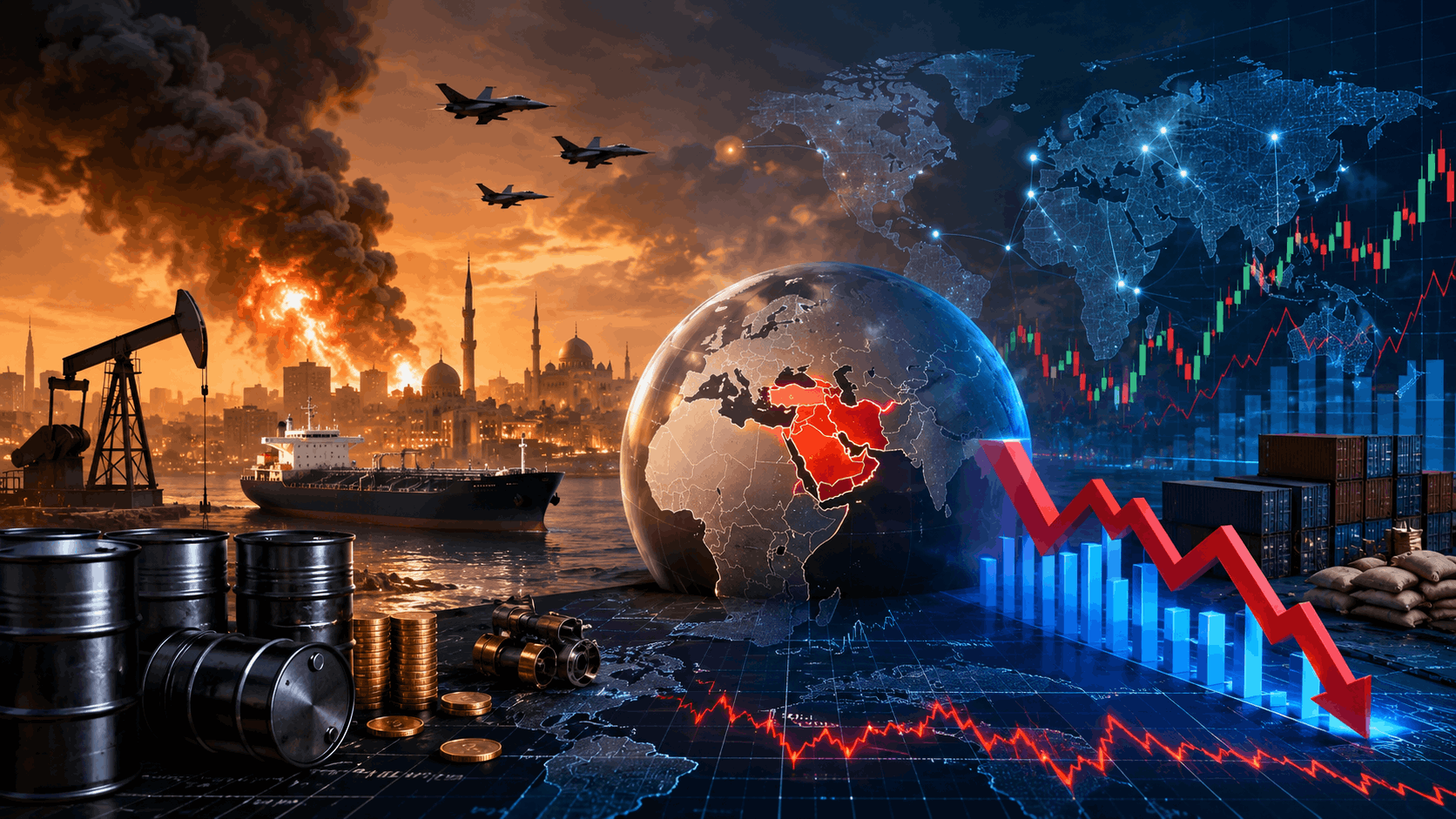
The Middle East conflict and global markets have become one of the most important business and finance stories of 2026. The impact extends well beyond the region because the Middle East plays a critical role in global energy supplies, shipping routes and international trade.
The Strait of Hormuz has been at the center of market concerns. The World Bank notes that roughly one-fifth of global oil consumption and liquefied natural gas trade normally moves through the waterway, making disruptions especially significant for energy markets.
The financial impact can move through several interconnected channels:
Conflict → Energy Supply Disruption → Higher Oil Prices → Higher Inflation → Interest-Rate Pressure → Stock-Market Volatility
As of August 2026, markets are also responding to uncertainty around efforts to reopen the Strait of Hormuz. Reuters reported that negotiations involving Iran and Oman could potentially restore vital energy shipments, but uncertainty over the terms of reopening continues to influence oil prices and investor sentiment.
Table of Contents
Why the Middle East Conflict Matters to Global Markets
Geopolitical conflicts can affect financial markets even when the fighting is geographically concentrated.
The Middle East is particularly important because disruptions can affect:
- Crude oil supplies
- Natural gas markets
- Shipping and insurance costs
- Fertilizer prices
- Global supply chains
- Inflation expectations
- Currency markets
- Interest-rate expectations
- Stock-market sentiment
The IMF has described the conflict as a global financial-market shock, noting that higher energy prices and inflation concerns can push bond yields higher and weigh on risk assets.
This makes the conflict not just a geopolitical issue but also a global business and investment story.
Middle East Conflict and Oil Prices: The Biggest Market Channel
Oil is arguably the most immediate financial-market transmission mechanism.
When investors fear disruptions to crude production or transportation, oil prices can rise quickly as markets price in the possibility of tighter supply.
The Strait of Hormuz is especially important because of the enormous volume of energy products that normally pass through it. The IMF reported that disruptions during the conflict caused major reductions in crude flows and pushed Brent prices sharply higher earlier in 2026.
More recently, oil markets have remained highly sensitive to developments around the conflict. On August 7, Reuters reported Brent ending at $83.55 per barrel, up 1.3%, as uncertainty remained over plans to reopen the Strait.
This demonstrates how quickly geopolitical developments can translate into commodity-market movements.
How Higher Oil Prices Can Increase Global Inflation
Higher oil prices can affect inflation in two ways.
First, consumers may face higher prices for petrol, diesel, transportation and energy.
Second, businesses may face higher costs for:
- Manufacturing
- Logistics
- Aviation
- Agriculture
- Chemicals
- Packaging
- Electricity
- Fertilizer
- Shipping
Companies may eventually pass some of these additional costs to consumers.
The World Bank and IMF have warned that the conflict’s energy shock can spread into food, fertilizer and other commodity markets, creating broader inflationary pressure.
For energy-importing countries, the effect can be particularly significant because higher oil prices increase the cost of importing essential commodities.
Could the Middle East Conflict Delay Interest-Rate Cuts?
This is one of the biggest questions for investors in 2026.
Central banks typically want inflation to move sustainably toward their targets. But an oil-price shock can create inflationary pressure even when economic growth is slowing.
That creates a difficult policy situation:
Higher oil prices → Higher inflation → Less room for rate cuts
If energy prices remain elevated for an extended period, central banks could become more cautious about reducing interest rates.
The IMF has warned that higher energy prices and renewed inflation concerns can lead to tighter financial conditions.
For businesses and consumers, delayed rate cuts could mean borrowing costs remain higher for longer.
Impact on Global Stock Markets
Stock markets often react to geopolitical uncertainty before the full economic consequences become clear.
Investors may reduce exposure to riskier assets when they fear:
- Higher energy costs
- Slower economic growth
- Higher inflation
- Delayed monetary easing
- Lower corporate earnings
- Supply-chain disruptions
The IMF reported that the initial conflict shock brought an equity-market correction and higher volatility, alongside rising energy prices and changing currency conditions.
However, the impact is not identical across sectors.
Which Stock Market Sectors Could Benefit?
A conflict-driven energy shock can create both winners and losers in financial markets.
Energy Stocks
Oil and gas producers may benefit from higher crude prices, although production disruptions and operational risks can offset some gains.
Defense Stocks
Higher geopolitical tensions can increase expectations for defense spending and military procurement.
Shipping and Logistics
Companies may experience higher costs because of route changes, insurance premiums and longer transit times.
Airlines and Travel Stocks
Higher fuel prices and disruption to regional air traffic can put pressure on airline profitability and tourism-related businesses.
Consumer and Industrial Companies
Businesses dependent on fuel, transportation and imported raw materials may face higher operating costs.
The result is often a more uneven stock market, where energy-related businesses can outperform while fuel-sensitive sectors come under pressure.
Impact on Emerging Markets and Oil-Importing Economies
Emerging markets can be particularly vulnerable to an oil-price shock.
Countries that import large amounts of energy may face:
- Higher import bills
- Currency depreciation
- Wider current-account deficits
- Higher inflation
- Increased fiscal pressure
- Higher borrowing costs
The IMF estimates that, for the average MENAP emerging-market oil importer, a 10% increase in crude oil prices can reduce output by about 0.5 percentage point and increase inflation by roughly 1 percentage point.
This illustrates why rising oil prices can be much more damaging for energy-importing economies than for major oil exporters.
What Does the Conflict Mean for India?
India is particularly sensitive to global crude oil prices because it is a major energy importer.
A sustained increase in crude prices can affect:
- Petrol and diesel costs
- Transportation expenses
- Inflation
- Corporate margins
- The rupee
- Current-account conditions
- Interest-rate expectations
- Indian stock-market sentiment
Higher energy costs can also affect industries that depend heavily on transportation and imported inputs.
For Indian investors, the Middle East conflict therefore matters even when domestic economic fundamentals remain relatively strong.
Impact on the US Dollar and Safe-Haven Assets
Geopolitical uncertainty can influence currency markets as investors reassess risk.
During periods of market stress, investors may move toward assets perceived as relatively defensive or liquid, including the US dollar and government bonds, although market reactions can vary depending on inflation and interest-rate expectations.
Gold can also attract attention as investors seek diversification during periods of geopolitical uncertainty.
However, safe-haven behavior is not guaranteed. If higher oil prices lead to stronger inflation expectations and higher interest rates, different asset classes can respond in unexpected ways.
Can Higher Oil Prices Trigger Stagflation?
One of the biggest economic risks from a prolonged Middle East conflict is stagflation.
Stagflation occurs when an economy experiences:
High Inflation + Weak Economic Growth
A prolonged energy shock can contribute to this combination by increasing production costs while simultaneously reducing consumer purchasing power.
The World Bank has warned that sustained energy disruptions could create inflationary pressures while weakening economic activity.
This is particularly challenging for policymakers because measures designed to fight inflation can further slow economic growth.
Strait of Hormuz: Why Investors Are Watching It Closely
The Strait of Hormuz remains one of the most important variables for global energy markets.
A stable reopening could ease supply concerns and potentially reduce the geopolitical premium in crude prices.
A prolonged disruption, however, could increase:
- Oil-price volatility
- Shipping costs
- Insurance premiums
- Inflation expectations
- Supply-chain pressure
- Market uncertainty
Current developments remain fluid. Reuters reported on August 7 that negotiations over reopening the waterway were progressing but that disagreements over shipping conditions, fees and access remained unresolved.
Therefore, investors are closely monitoring both physical energy flows and diplomatic developments.
How Businesses Can Manage Middle East Conflict Risks
Businesses can reduce exposure to geopolitical shocks through better risk management.
Some strategies include:
- Diversifying energy suppliers
- Building alternative logistics routes
- Managing inventory strategically
- Using appropriate energy hedging
- Diversifying international suppliers
- Strengthening supply-chain visibility
- Monitoring currency exposure
- Maintaining adequate liquidity
The World Bank has emphasized the importance of strengthening energy and food security and improving resilience to future shocks.
For companies, resilience is increasingly becoming a competitive advantage rather than simply a contingency plan.
What Should Investors Watch Next?
Investors following the Middle East conflict and global markets should monitor several indicators closely.
1. Oil Prices
Watch Brent and WTI prices for signs of persistent supply pressure.
2. Strait of Hormuz Traffic
A sustained normalization of shipping could reduce the geopolitical risk premium in energy prices.
3. Inflation Data
Higher energy prices can influence headline inflation and eventually broader price expectations.
Markets will closely watch whether central banks continue to prioritize inflation control or shift toward supporting economic growth.
5. Bond Yields
Rising yields can signal changing expectations around inflation and monetary policy.
6. Stock-Market Volatility
Sharp movements in major indexes can indicate changing investor risk appetite.
7. Currency Markets
Energy-importing economies may experience greater pressure on their currencies if crude prices remain high.
Middle East Conflict: Opportunity or Risk for Investors?
The answer depends heavily on the duration and intensity of the conflict.
A short-lived disruption followed by stable reopening of critical shipping routes could allow oil prices and market volatility to normalize.
A prolonged disruption, on the other hand, could create a more serious combination of higher energy prices, inflation, weaker growth and tighter financial conditions.
This is why investors should avoid making decisions based solely on a single headline.
Instead, they should assess:
- Company fundamentals
- Valuations
- Energy exposure
- Debt levels
- Cash flows
- Geographic exposure
- Portfolio diversification
- Overall risk tolerance
Global Market Outlook for the Rest of 2026
The rest of 2026 could remain highly sensitive to developments in the Middle East.
Current conditions suggest that markets are balancing two competing possibilities: de-escalation and normalization versus renewed disruption and higher energy prices.
The World Bank said in July that the global economy had remained broadly resilient despite the shock, but noted that energy markets and goods transit were still under strain and uncertainty remained high.
That means the market outlook may depend less on the existence of the conflict itself and more on whether disruptions to energy and trade become persistent.
Final Takeaway: Middle East Conflict and Global Markets
The Middle East conflict and global markets are closely connected through oil, shipping, inflation, interest rates and investor sentiment.
The most important transmission channel remains energy. A sustained disruption to oil and gas supplies can raise production and transportation costs, increase inflation and potentially delay monetary easing.
For stock markets, the impact is likely to remain uneven. Energy producers may benefit from higher commodity prices, while airlines, transportation businesses and other fuel-intensive sectors may face greater pressure.
The biggest risk is a prolonged shock that transforms a geopolitical crisis into a broader inflation and global-growth problem.
For businesses and investors, the key is to watch the fundamentals rather than react emotionally to headlines. Oil prices, Hormuz shipping flows, inflation expectations, central-bank policy, bond yields and corporate earnings will remain important indicators of where global markets go next.

References


