
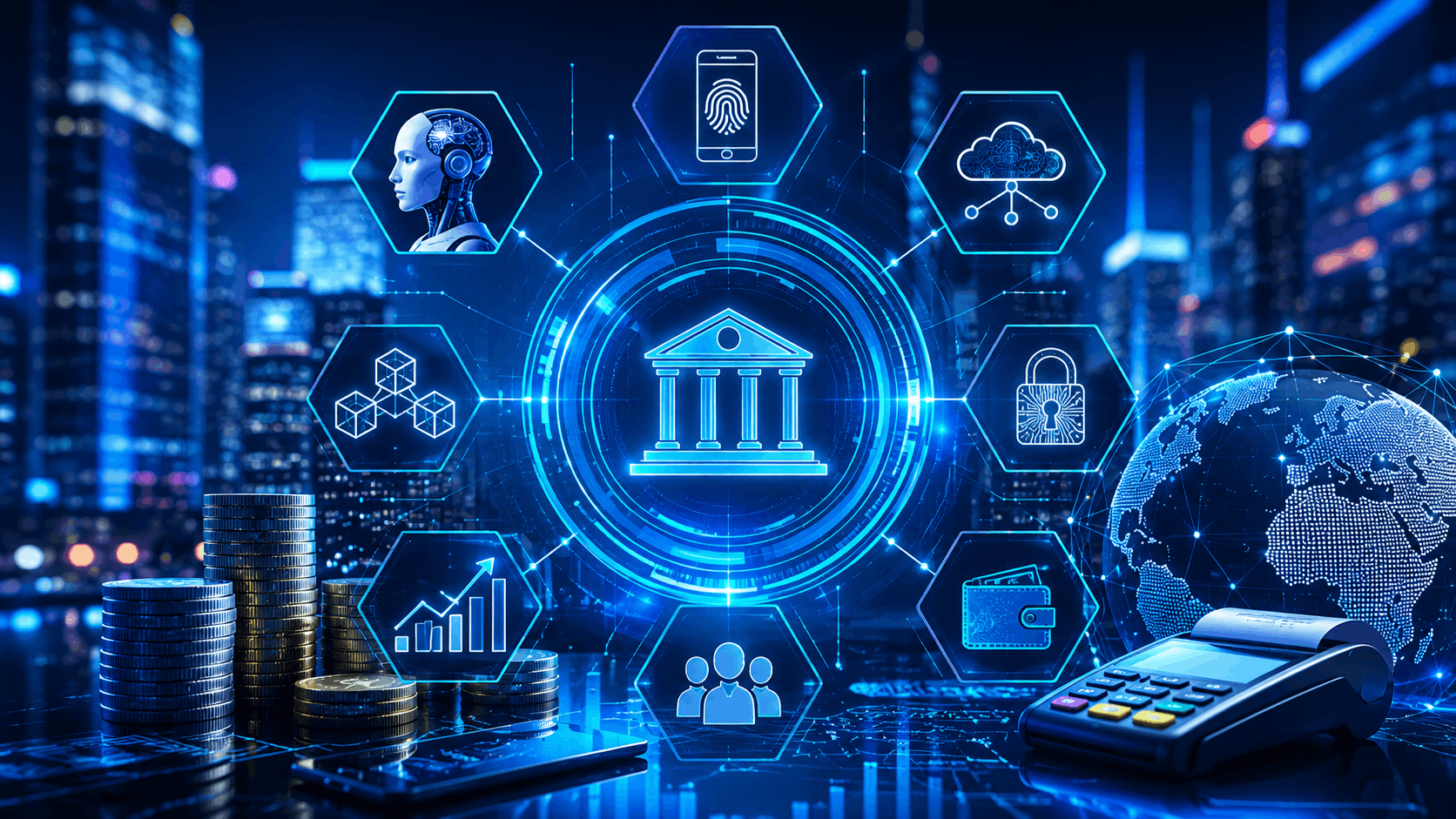
The financial services industry is entering another major phase of digital transformation in 2026. Fintech is no longer limited to mobile banking apps, digital wallets or online payments. The next wave is being driven by artificial intelligence, real-time payment infrastructure, embedded finance, open banking, digital identity, stablecoins and automated financial services.
One of the biggest changes is the move from technology that simply assists customers to technology that can predict, recommend and potentially execute financial tasks. Industry research identifies cloud-powered AI agents, generative AI and embedded finance as major forces reshaping banking in 2026.
At the same time, rapid innovation is creating new challenges around fraud, cybersecurity, privacy, regulation and consumer trust. This makes 2026 an important year for banks, fintech companies, investors and businesses trying to understand where financial services are heading.
Table of Contents
- AI-Powered Banking Is Becoming a Core FinTech Trend
- Open Banking Is Evolving Into Open Finance
- Stablecoins and Tokenized Assets Are Entering Financial Infrastructure
- Banking-as-a-Service Is Entering a New Phase
- What FinTech Trends Mean for Banks and Financial Institutions
- Biggest Risks Facing the FinTech Industry in 2026
- Final Takeaway: The Biggest FinTech Changes in 2026
AI-Powered Banking Is Becoming a Core FinTech Trend
Artificial intelligence is arguably the most important technology shaping FinTech trends in 2026.
Banks and fintech companies are increasingly using AI beyond basic customer-service chatbots. AI is being integrated into underwriting, fraud detection, KYC verification, compliance monitoring, collections, customer support and internal operations.
AI can help financial institutions:
- Analyze large amounts of financial data
- Identify unusual transactions
- Automate repetitive processes
- Improve customer personalization
- Support credit decisions
- Detect potential fraud
- Improve compliance monitoring
- Reduce operational costs
This shift could make financial services faster and more personalized while allowing institutions to manage growing transaction volumes more efficiently.
Agentic AI Could Change How People Use Financial Services
The next stage of AI in fintech is moving toward agentic AI.
Instead of simply answering a customer’s question, an AI agent could potentially compare financial products, analyze spending patterns, recommend actions and complete multi-step tasks with appropriate authorization.
This could change the traditional relationship between customers and financial institutions.
For example, instead of manually searching through different financial products, customers could eventually use AI-powered financial assistants to compare options based on their financial goals.
However, financial institutions will need strong safeguards because autonomous systems handling financial decisions introduce questions around accuracy, accountability, transparency and consumer protection.
Real-Time Payments Are Becoming the New Standard
Another major FinTech trend in 2026 is the continued expansion of real-time payments.
Consumers and businesses increasingly expect money to move instantly rather than waiting for traditional settlement periods.
Real-time payment infrastructure can benefit:
- Retail transactions
- Business payments
- Payroll
- Cross-border transactions
- E-commerce
- Small businesses
- Financial institutions
The growth of real-time payment networks is also creating opportunities for fintech companies to build new financial products around instant settlement and account-to-account payments. Current fintech research identifies real-time payment infrastructure as one of the major developments shaping the industry.
Embedded Finance Is Moving Beyond Payments
Embedded finance is another major transformation in financial services.
The concept involves integrating financial products directly into non-financial platforms. Instead of visiting a bank separately, customers can access payments, lending, insurance or other financial services while using an e-commerce platform, business application or marketplace.
For example, a business platform could provide:
- Embedded payments
- Working-capital financing
- Insurance
- Business banking
- Expense management
- Digital wallets
This creates new opportunities for both fintech companies and traditional financial institutions.
For businesses, embedded finance can improve customer convenience while creating additional revenue streams.
Open Banking Is Evolving Into Open Finance
Open banking has already changed how financial data can be shared between institutions and authorized third-party providers.
In 2026, the broader movement is increasingly toward open finance, where data connectivity can extend beyond traditional bank accounts into areas such as investments, insurance, pensions and mortgages.
API-based financial infrastructure can allow different financial services to communicate more efficiently.
For consumers, this could mean greater control over their financial information and more personalized financial products.
For fintech companies, access to authorized financial data can support better credit assessments, financial planning and product recommendations.
AI-Powered Fraud Detection Is Becoming Essential
The growth of digital finance also brings a growing cybersecurity challenge.
Fraudsters can use AI to create convincing scams, synthetic identities, deepfakes and automated attacks. As a result, traditional fraud detection methods may not always be sufficient.
Financial institutions are increasingly moving toward real-time behavioral analysis and AI-powered fraud detection.
Instead of relying only on a single transaction or authentication event, modern systems can analyze patterns across multiple interactions to identify suspicious behavior.
Thomson Reuters notes that AI-powered fraud is becoming more coordinated and that financial institutions need stronger behavioral signals and collaboration to combat evolving threats.
This means cybersecurity is no longer just an IT concern. It is becoming a central part of fintech strategy and customer trust.
Digital Identity and Smarter KYC
Digital identity is another important development for financial services in 2026.
Banks and fintech companies need reliable ways to verify customers while reducing friction during onboarding.
AI, biometric technologies and digital identity infrastructure can potentially make Know Your Customer (KYC) processes faster and more secure.
However, financial institutions must balance convenience with privacy and security. Deepfakes and synthetic identities are creating new challenges for identity verification, making stronger authentication increasingly important.
Stablecoins and Tokenized Assets Are Entering Financial Infrastructure
Digital assets are also becoming increasingly relevant to the fintech industry.
One major development is the growing discussion around stablecoins, which are designed to maintain relatively stable values and can potentially support payments and settlement.
Stablecoins could have particular relevance for cross-border transactions, where traditional payment systems can be slower and more expensive.
Another emerging area is tokenization, where real-world financial assets can be represented digitally on blockchain-based infrastructure.
Industry forecasts for 2026 identify stablecoins and tokenized assets as important developments that could influence how financial transactions and settlement systems operate.
The pace of adoption, however, will depend heavily on regulation, infrastructure and institutional trust.
Banking-as-a-Service Is Entering a New Phase
Banking-as-a-Service (BaaS) allows non-bank companies to offer certain financial products and services through partnerships and technology infrastructure.
The model can help companies launch financial products without building a traditional banking infrastructure from scratch.
However, the industry is becoming more focused on:
- Regulatory compliance
- Risk management
- Sustainable business models
- Customer protection
- Stronger infrastructure
- Better partnerships between banks and fintechs
This suggests the next phase of BaaS may focus less on rapid expansion and more on compliance, reliability and sustainable growth.
Personalized Financial Services Will Become More Data-Driven
Customers increasingly expect financial products to be tailored to their individual needs.
AI and financial data can help institutions provide more personalized recommendations for:
- Saving
- Spending
- Credit
- Investments
- Insurance
- Financial planning
Instead of offering the same product to every customer, fintech platforms can increasingly use data to create more relevant financial experiences.
However, personalization also raises important questions about data privacy and responsible use of customer information.
FinTech Regulation and Compliance Will Become More Important
Innovation cannot develop independently from regulation.
As financial services become increasingly automated and interconnected, regulators are paying greater attention to AI, digital assets, consumer protection, cybersecurity, data privacy and financial stability.
This means fintech companies will need to build compliance into their technology rather than treating it as an afterthought.
For financial institutions, the ability to innovate while maintaining security, transparency and regulatory compliance could become a major competitive advantage.
What FinTech Trends Mean for Banks and Financial Institutions
Traditional banks are not simply being replaced by fintech companies. Instead, the financial services industry is becoming increasingly interconnected.
Banks are partnering with fintech firms, adopting AI, modernizing payment infrastructure and developing API-based services.
The competitive landscape is therefore shifting from:
Traditional Banking vs. Fintech
toward:
Banks + Fintech + Technology Platforms + Digital Infrastructure
The institutions that successfully combine technology with trust, regulatory expertise and customer relationships could be well positioned for the next stage of financial services.
What FinTech Trends Mean for Businesses and Investors
Businesses can benefit from fintech innovation through faster payments, easier access to financing, automated accounting and more efficient financial management.
For investors, the fintech opportunity extends beyond consumer-facing apps.
Potential growth areas include:
- AI financial technology
- Payment infrastructure
- Fraud prevention
- Digital identity
- Cloud banking
- Embedded finance
- Open banking APIs
- Data infrastructure
- Stablecoin infrastructure
- Financial cybersecurity
Investors should still evaluate valuations, profitability, competitive advantages and regulatory risks rather than investing solely because a company operates in a high-growth technology category.
Biggest Risks Facing the FinTech Industry in 2026
The fintech opportunity comes with significant risks.
Cybersecurity Risks
More digital transactions create more opportunities for cyberattacks and fraud.
AI Risks
Incorrect, biased or poorly governed AI systems could create financial and regulatory problems.
Regulatory Uncertainty
Rapidly changing rules can increase compliance costs and affect fintech business models.
Data Privacy
Greater access to financial data increases the importance of protecting customer information.
Market Competition
Traditional banks, fintech startups and large technology companies are increasingly competing in the same financial ecosystem.
Consumer Trust
Financial services depend heavily on trust. A major security or privacy failure could damage customer confidence.
What Is the Future of FinTech in 2026 and Beyond?
The future of fintech is likely to be less about individual apps and more about connected financial infrastructure.
AI could provide intelligence. Open banking can provide data connectivity. Real-time payment systems can provide speed. Embedded finance can distribute financial services across different platforms. Digital identity and cybersecurity can provide trust.
These technologies are increasingly working together rather than developing separately.
The result could be a financial system that is more automated, personalized, connected and available in places where consumers and businesses already operate.
Final Takeaway: The Biggest FinTech Changes in 2026
The FinTech Trends 2026 story is ultimately about the convergence of technology and financial services.
AI is moving deeper into banking operations, real-time payments are changing expectations around money movement, embedded finance is bringing financial products into non-financial platforms, and open finance is expanding data connectivity. At the same time, stablecoins, tokenized assets and digital identity are creating new possibilities for financial infrastructure.
But innovation alone will not determine the winners.
The most successful financial institutions and fintech companies will likely be those that combine technology, security, regulatory compliance, customer trust and sustainable business models.
For businesses and investors, 2026 could therefore be an important turning point—not just for fintech companies, but for the future of the entire financial services industry.

References


