
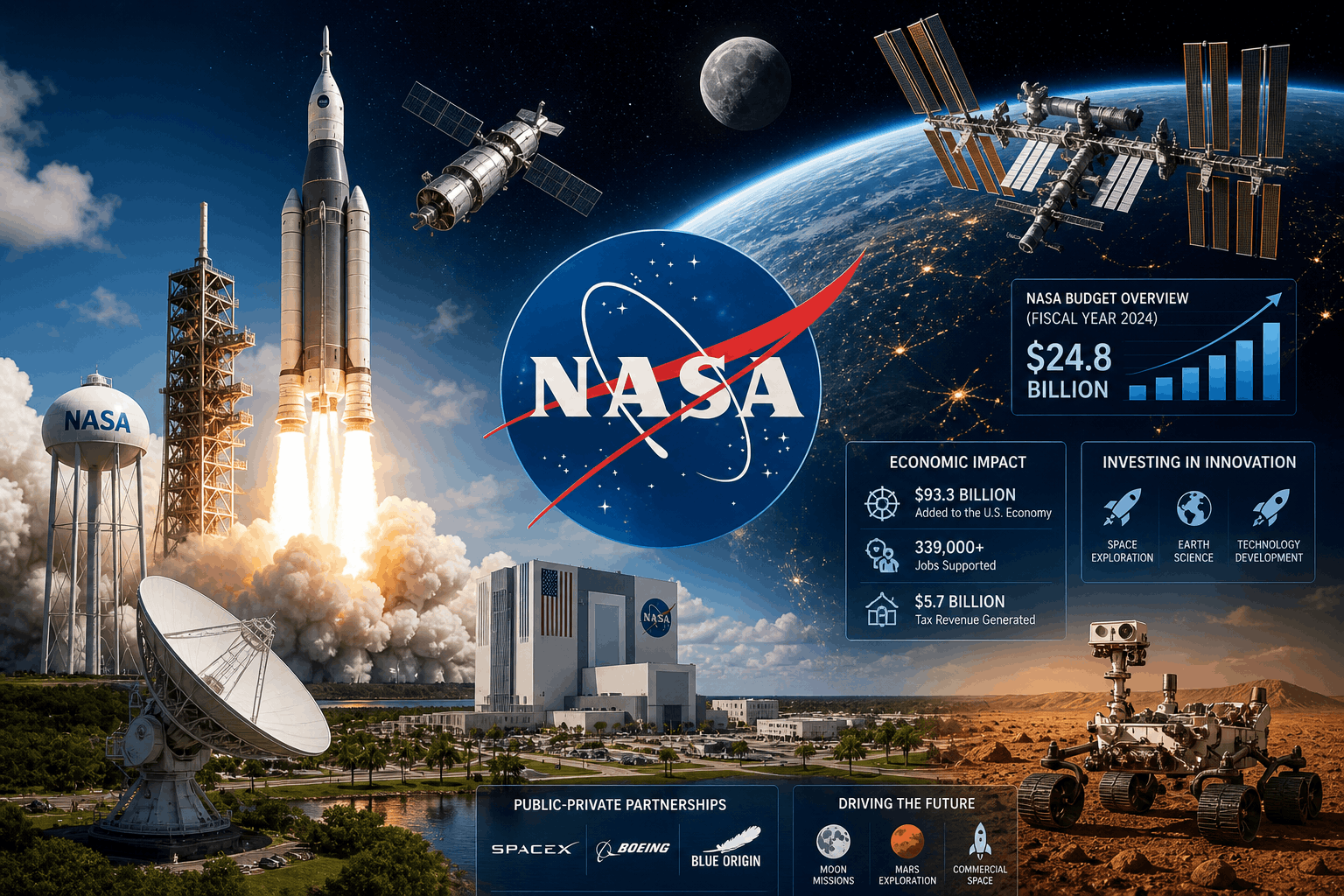
NASA (National Aeronautics and Space Administration) is not just a space exploration agency—it is a major driver of economic activity, technological advancement, and global business transformation. Over the decades, NASA has influenced multiple industries by funding innovation, supporting private companies, and enabling scientific breakthroughs that later translate into commercial success.
From a business and finance perspective, NASA acts as a catalyst for growth by injecting capital into high-tech sectors, encouraging competition, and reducing barriers for private space companies. Its role in shaping the modern space economy is comparable to how government infrastructure spending fuels industrial growth.
Table of Contents
What Is NASA?
NASA is a U.S. government agency established in 1958 with the mission to explore space, advance aeronautics, and conduct scientific research.
NASA has led groundbreaking missions such as:
- Apollo Moon missions
- Mars rover explorations
- Hubble Space Telescope operations
- International Space Station (ISS) collaborations
While NASA’s primary goal is scientific discovery, its activities generate long-term economic value by fostering innovation and creating new markets.
NASA’s Budget and Funding Structure
NASA operates through a structured funding model supported by the U.S. government.
Annual Budget Allocation
NASA receives tens of billions of dollars annually, making it one of the largest publicly funded research organizations in the world. These funds are allocated across multiple programs, including human spaceflight, planetary science, and Earth observation.
Multi-Year Program Funding
Large missions such as lunar exploration or Mars missions require funding over several years. This ensures continuity and stability in long-term projects.
Capital-Intensive Investments
Space missions require high upfront investment in technology, infrastructure, and research. These investments often lead to innovations that benefit commercial industries.
Additionally, NASA’s budget planning must account for inflation, technological upgrades, and evolving mission requirements, making financial management a complex process.
Business Model and Public-Private Partnerships
NASA has shifted from a purely government-driven model to a collaborative approach involving private companies.
Collaboration with Private Space Companies
NASA partners with organizations like SpaceX, Blue Origin, and Boeing to develop spacecraft, launch systems, and space technologies.
Cost Reduction Through Outsourcing
By outsourcing certain operations, NASA reduces operational costs while encouraging innovation and competition in the private sector.
Commercialization of Space
NASA supports private companies in building commercial space stations, satellite systems, and tourism ventures, creating new revenue streams in the space economy.
This partnership model has significantly transformed the aerospace industry into a dynamic and competitive market.
Economic Impact of NASA
NASA’s influence on the economy extends across multiple sectors.
Job Creation and Workforce Development
NASA programs generate thousands of high-skilled jobs in engineering, research, and manufacturing. It also supports education and training in STEM fields.
Technology Transfer and Innovation
Technologies developed by NASA often find applications in everyday industries such as healthcare, telecommunications, and environmental science.
Boost to National and Global Economy
NASA’s spending stimulates economic growth by supporting contractors, suppliers, and service providers. This creates a multiplier effect across the economy.
Furthermore, NASA’s projects encourage international collaboration, strengthening global economic ties.
Financial Impact on Aerospace Industry
NASA plays a central role in shaping the aerospace industry’s financial landscape.
- Provides long-term contracts to aerospace companies
- Encourages research and development investments
- Enhances competitiveness among private firms
Companies working with NASA often gain credibility, which helps them secure additional contracts and investments.
Revenue Streams and Indirect Economic Benefits
Although NASA is not a profit-generating entity, it creates indirect revenue opportunities.
- Satellite launches enable global communication services
- GPS and navigation technologies support transportation industries
- Climate monitoring systems benefit agriculture and environmental planning
These indirect benefits highlight NASA’s broader financial contribution to society.
Challenges and Financial Risks
NASA faces several financial and operational challenges.
- Budget limitations due to political decisions
- High cost of advanced space missions
- Delays caused by technical complexities
- Dependence on government funding cycles
Additionally, managing partnerships with private companies requires balancing cost efficiency with mission reliability.
Future Outlook of NASA
The future of NASA is focused on ambitious exploration and commercial expansion.
Artemis Program and Lunar Missions
NASA aims to return humans to the Moon, creating opportunities for long-term space exploration.
Mars Exploration
Future missions are expected to focus on human exploration of Mars, opening new frontiers.
Growth of Commercial Space Economy
NASA will continue to support private companies in developing space infrastructure, including space stations and transportation systems.
As technology advances, NASA’s role is expected to shift further toward enabling and regulating commercial space activities.
Strategic Insights for Businesses and Investors
- NASA drives innovation across multiple industries
- Government funding creates stable opportunities for contractors
- Public-private partnerships are shaping the future of space business
- Long-term projects offer sustained economic benefits
- Emerging technologies present new investment opportunities
NASA is a powerful force in both scientific discovery and economic development. Its influence extends far beyond space exploration, impacting industries, businesses, and global markets.
By fostering innovation, supporting private sector growth, and investing in future technologies, NASA continues to play a critical role in shaping the global economy. For businesses and investors, it represents a unique opportunity to understand how government initiatives can drive long-term growth and transformation.
