
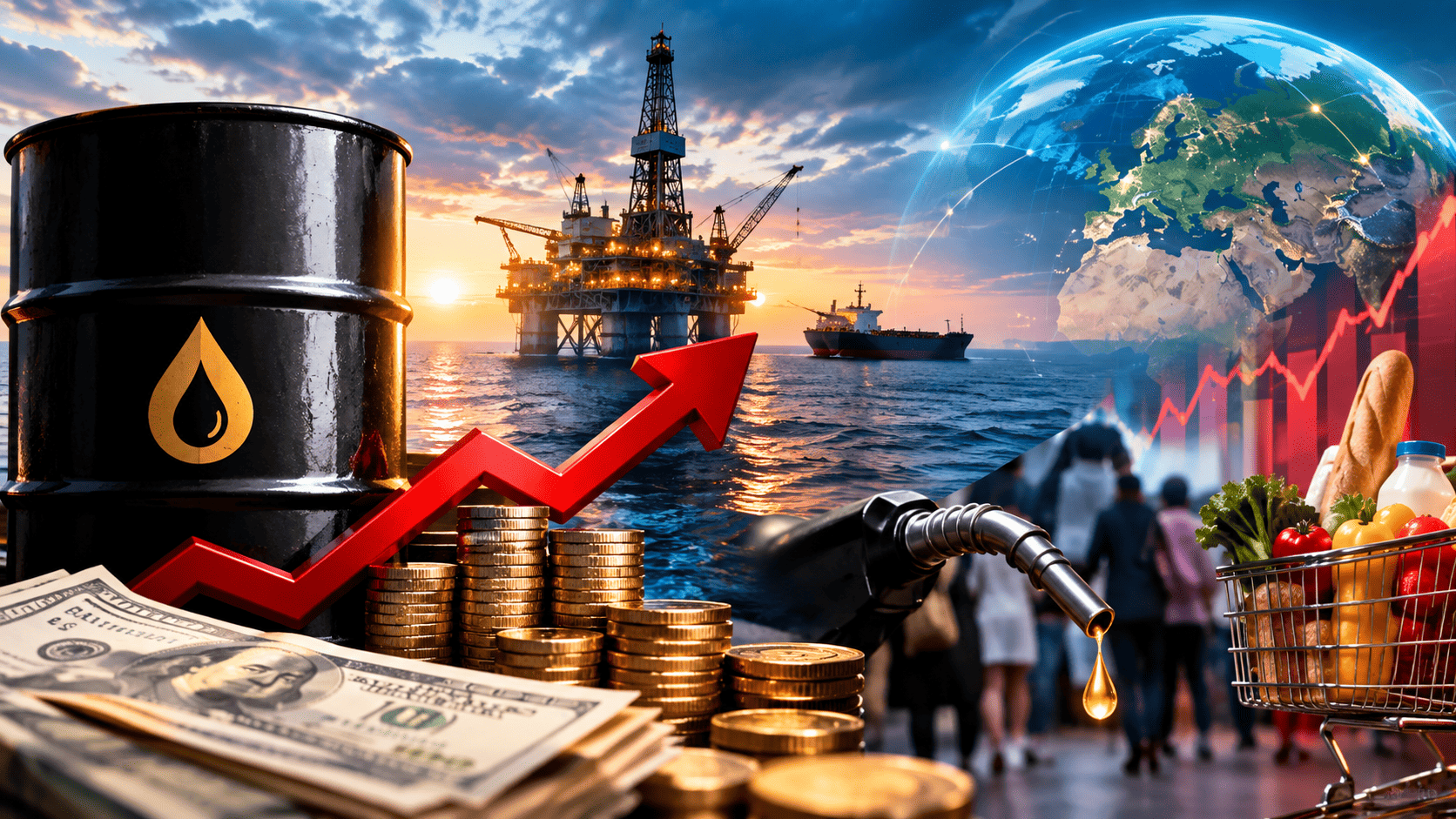
The global economy is facing a fresh energy-price challenge as Brent crude oil moves above $100 per barrel in September 2026. The sharp rise in oil prices has renewed concerns about inflation, interest rates, business costs, consumer spending, and global economic growth.
Brent crude settled at around $101.21 per barrel on September 9, 2026, its highest level since May, while U.S. West Texas Intermediate (WTI) also moved sharply higher. The latest surge has been linked to escalating Middle East tensions, attacks involving oil infrastructure and shipping, and growing concerns about disruptions to global crude supplies.
The important question for investors and businesses is no longer simply “How high can oil go?” It is whether oil prices can remain above $100 long enough to create a broader global inflation shock.
Table of Contents
Why Is Oil Above $100 in 2026?
The latest oil rally is largely a supply-side shock rather than a simple increase in global consumer demand.
Escalating conflict involving the United States and Iran, attacks on energy infrastructure in Saudi Arabia, and disruption risks around important shipping routes have increased concerns about the availability of crude oil.
The Strait of Hormuz is particularly important because it is one of the world’s most critical energy shipping routes. Recent disruptions have sharply reduced oil flows through the area, increasing the risk premium built into crude prices.
Oil prices had already been under pressure earlier in 2026. According to the U.S. Energy Information Administration, Brent averaged approximately $91 per barrel in August, up from $84 in July, as Middle East exports remained constrained.
The move above $100 therefore represents another major escalation in an already-tight energy market.
Could $100 Oil Trigger Another Inflation Shock?
Yes, but the impact will depend heavily on how long oil remains above $100.
A temporary spike may increase headline inflation without creating a prolonged economic problem. However, sustained high oil prices can spread through the economy.
The transmission mechanism is relatively straightforward:
Higher crude prices → higher fuel costs → higher transportation costs → higher production costs → higher consumer prices → stronger inflation pressure.
Oil is not only used for gasoline and diesel. It affects transportation, chemicals, plastics, fertilizers, manufacturing, logistics, aviation, and many other industries.
Recent economic data from China already provides an example of this transmission effect. China’s August 2026 consumer inflation increased to 0.8% year over year from 0.5% in July, while producer inflation accelerated to 3.8%. Reuters reported that higher international crude and commodity prices contributed to rising costs across related industries.
Energy Prices Could Push Up Transportation Costs
One of the fastest ways an oil shock reaches consumers is through transportation.
Higher crude prices can increase the cost of:
- Gasoline
- Diesel
- Trucking
- Shipping
- Air travel
- Public transportation
- Delivery services
When transportation becomes more expensive, companies often face higher distribution costs.
Businesses may absorb some of these expenses temporarily, but if energy prices remain elevated, many companies eventually pass part of the additional cost to customers.
This creates a second-round inflation effect.
For example, a manufacturer may pay more to transport raw materials. The manufacturer then faces higher production costs and may increase wholesale prices. Retailers subsequently face higher costs and may raise prices for consumers.
That is how an energy shock can become a broader inflation problem.
The Biggest Risk: Stagflation
One of the biggest economic risks associated with prolonged oil prices above $100 is stagflation.
Stagflation occurs when an economy experiences:
High inflation + weak economic growth + weaker consumer purchasing power
This is particularly difficult for policymakers because the traditional tools for fighting inflation can make economic growth even weaker.
Higher interest rates can reduce inflation by slowing demand. But when inflation is caused by an energy supply shock, higher rates cannot directly produce more oil.
This creates a difficult policy dilemma for central banks.
What Could Higher Oil Prices Mean for Interest Rates?
Oil above $100 could complicate the decisions of major central banks.
If energy prices push headline inflation higher, central banks may become more cautious about cutting interest rates.
Markets are already watching this issue closely because higher energy costs could make inflation remain elevated for longer.
The problem becomes more serious if businesses and workers begin adjusting their expectations around higher prices and wages.
In that situation, an initial energy shock can potentially develop into broader second-round inflation pressures.
Recent market reactions show why investors are concerned. Higher oil prices have been accompanied by rising bond yields and renewed uncertainty about future monetary policy.
How Could Oil Above $100 Affect Businesses?
Businesses could face a major margin squeeze if energy prices remain elevated.
Companies with high transportation or energy requirements are particularly vulnerable.
Industries Most Exposed to Higher Oil Prices
Airlines:
Jet fuel represents a major operating expense for airlines. Sustained crude prices above $100 could increase ticket prices or reduce airline profit margins.
Transportation and Logistics:
Trucking, shipping and delivery companies can face higher fuel expenses.
Manufacturing:
Factories may experience higher energy, transportation and raw-material costs.
Agriculture:
Higher diesel and fertilizer costs can increase farming expenses and eventually affect food prices.
Retail:
Retailers may face higher logistics costs and weaker consumer spending at the same time.
Chemicals and Plastics:
Oil and gas are important inputs for many petrochemical products, meaning higher energy costs can spread through industrial supply chains.
Which Businesses Could Benefit?
An oil-price shock does not affect every company negatively.
Energy producers can benefit from higher crude prices because stronger oil prices can increase revenue and cash flow.
Oil exploration, production, drilling, equipment and certain energy-service companies may also receive greater investor attention.
However, investors should remember that higher oil prices can also increase production costs for energy companies, especially those operating in higher-cost regions.
The broader market impact therefore depends on which part of the energy value chain a company operates in.
What Does $100 Oil Mean for Stock Markets?
Oil above $100 creates a complicated environment for equity investors.
Energy stocks may outperform because higher crude prices can improve earnings expectations.
At the same time, companies outside the energy sector may experience margin pressure.
The combination can create significant sector rotation.
Potential beneficiaries may include:
- Oil and gas producers
- Energy-service companies
- Some commodity producers
Potentially vulnerable sectors include:
- Airlines
- Transportation
- Consumer discretionary
- Chemicals
- Manufacturing
- Energy-intensive industries
The overall stock-market effect will depend on whether the oil shock remains temporary or develops into a prolonged supply crisis.
Could Oil Reach $120 or Higher?
A sustained move toward $120 per barrel cannot be ruled out if major supply disruptions continue.
Some market analysts are already warning that prolonged geopolitical disruptions could push prices significantly higher. Reuters reports that the current situation has left global energy markets vulnerable because of reduced supply and limited spare capacity.
However, investors should distinguish between a temporary price spike and a sustained oil supercycle.
If geopolitical tensions ease, disrupted production returns and shipping routes normalize, oil prices could fall quickly.
If supply disruptions continue for months, the economic consequences could become considerably larger.
Is This Another 2022-Style Energy Crisis?
Not necessarily.
There are similarities between the current environment and the 2022 energy shock, but the economic conditions are different.
BNP Paribas’ September 2026 analysis noted that, based on data available through August, the inflationary and economic impact of the current energy shock remained significantly lower than the 2022 shock, although renewed geopolitical tensions were pushing energy-related inflation higher.
That distinction is important.
A $100 oil price by itself does not automatically create a global inflation crisis.
The real danger comes from a combination of:
High oil prices + prolonged supply disruptions + rising transportation costs + increasing inflation expectations + weaker economic growth.
What Does This Mean for the Global Economy?
If oil remains above $100 for an extended period, global growth could slow.
Consumers would have less disposable income after paying more for fuel, electricity, transportation and other goods.
Businesses could postpone investment because operating costs become less predictable.
Central banks could face pressure to maintain restrictive monetary policies.
Governments could also face pressure to provide energy subsidies or other forms of consumer support.
This creates a difficult economic cycle:
Higher oil → higher inflation → tighter monetary policy → weaker demand → slower growth.
If the supply shock is severe enough, this can evolve into a broader stagflation risk.
What Should Investors Watch Next?
Investors should monitor several indicators over the coming weeks.
The most important question is whether Brent remains above $100 or quickly falls back below the level.
2. Global Oil Inventories
Falling inventories would indicate that supply disruptions are becoming more difficult to absorb.
3. Strait of Hormuz Shipments
Any further disruption to this critical energy route could create another major oil-price spike.
4. Inflation Data
Markets will closely watch consumer and producer inflation in the United States, Europe, China and other major economies.
Investors should watch whether inflation concerns change expectations for interest-rate cuts or hikes.
6. Corporate Earnings
Companies’ comments about fuel, transportation and raw-material costs will provide important clues about how quickly the oil shock is reaching businesses.
Could Higher Oil Prices Change the 2026 Investment Strategy?
The current environment could increase the importance of diversification.
Investors may want to pay closer attention to companies with:
- Strong balance sheets
- Low debt
- Pricing power
- Stable cash flow
- Lower energy dependence
- Resilient demand
Energy exposure can also act as a partial hedge against rising oil prices, although energy stocks themselves remain volatile and can fall sharply if geopolitical risks decline.
The key is not simply predicting the next oil-price target. Investors need to understand how different assets perform under different inflation and growth scenarios.
Final Outlook: Is a Global Inflation Shock Coming?
Oil above $100 in 2026 is a serious warning for the global economy, but it is too early to conclude that a full-scale global inflation shock is inevitable.
The biggest factor is duration.
If oil remains above $100 only briefly, the impact may be concentrated in headline inflation and energy-sensitive industries.
But if crude prices remain elevated for several months because of persistent supply disruptions, the consequences could become much broader.
Higher fuel costs could increase transportation and production expenses, reduce consumer purchasing power, pressure corporate margins and complicate central-bank decisions.
The current situation therefore creates a difficult combination for financial markets:
Expensive energy + persistent inflation + higher interest-rate uncertainty + slower growth risk.
For investors and businesses, the most important signal to watch is not simply whether oil touches $100. It is whether the global economy can absorb $100-plus oil without allowing temporary energy inflation to become persistent inflation.
For 2026, that may be one of the most important macroeconomic stories for markets, businesses and consumers to watch.
References
- Oil’s surge back above $100 fuels fresh inflation fears at a crucial time for interest rates
- Oil prices approach $100 as Middle East conflict flares, Goldman sees potential upside to $120
- Why Is Crude Oil Near $100 Again? Impact on Markets & Economy
- Oil Prices Surge Above $100 as Inflation Fears Grow, MoneySimpler Expands AI Automated Trading
- Oil Shock 2026: A Structural Turning Point for Global Markets


