
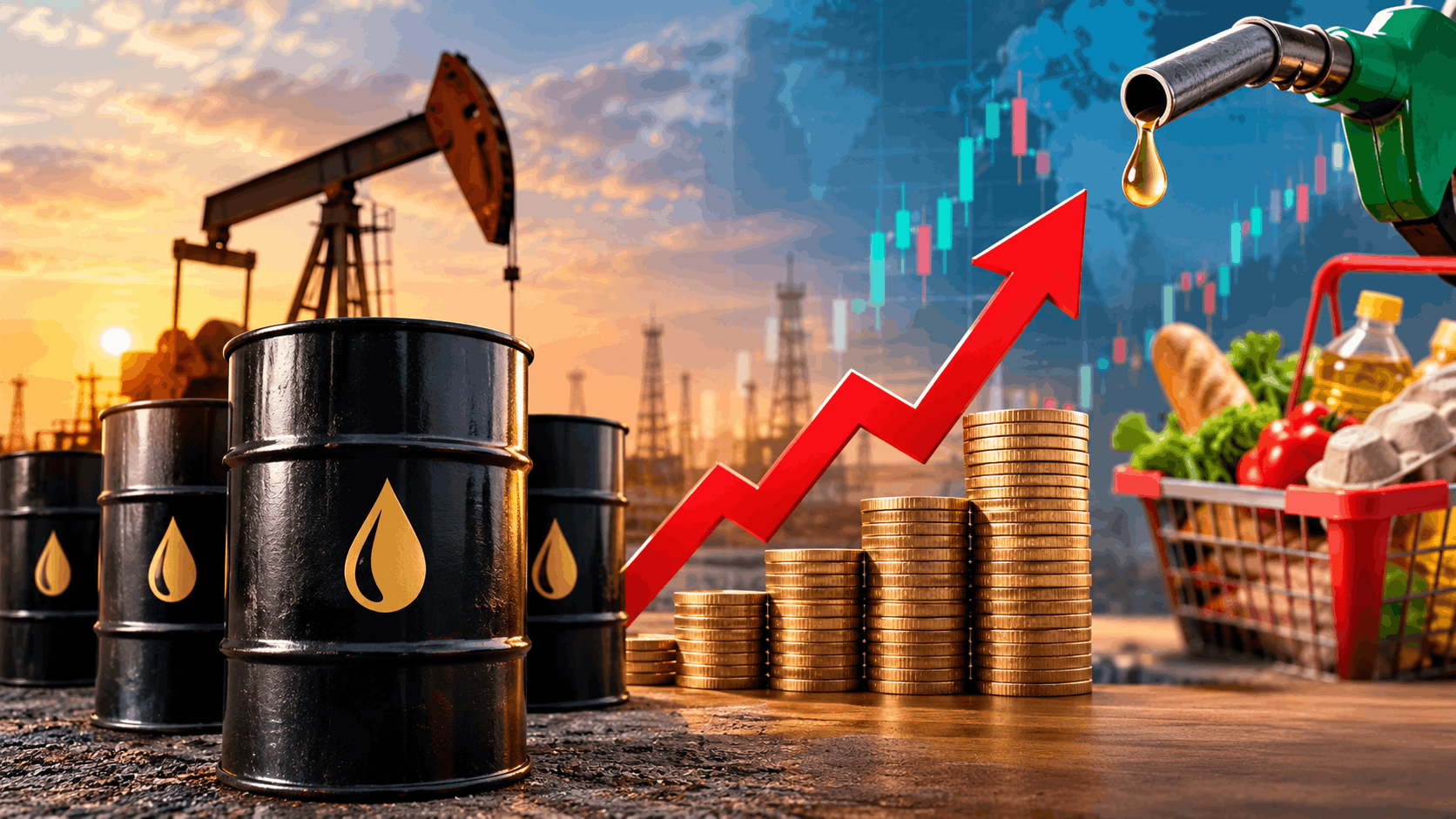
Oil prices are once again becoming one of the biggest risks for financial markets in September 2026. Brent crude has moved close to the psychologically important $100-per-barrel level, with renewed U.S.-Iran tensions and concerns around Middle East supply routes increasing fears of further disruptions.
The move matters far beyond the energy market. Higher crude prices can increase transportation, manufacturing and energy costs, potentially putting upward pressure on inflation. At the same time, persistent inflation could make central banks more cautious about lowering interest rates.
For investors, the key question is no longer simply “Will oil reach $100?” The bigger question is:
Could a sustained oil-price surge create another inflation shock and change the outlook for stocks, bonds, gold and interest rates in 2026?
Table of Contents
- Why Are Oil Prices Near $100 in 2026?
- Why Is the $100 Oil Level Important?
- Could Higher Oil Prices Trigger More Inflation?
- Why Is Oil Important for the Federal Reserve?
- Could the Fed Keep Interest Rates Higher?
- What Could Higher Oil Prices Mean for Stocks?
- Could Oil Prices Trigger a Stock Market Correction?
- What Happens to Gold When Oil Prices Rise?
- What Happens to the U.S. Dollar?
- What Does $100 Oil Mean for India?
- Which Indian Stocks Could Be Affected?
- What Could Happen If Oil Stays Above $100?
- What Could Bring Oil Prices Back Down?
- What Should Investors Watch This Week?
- Could $100 Oil Create a Global Inflation Shock?
- Oil Near $100: What Should Investors Do?
1. Why Are Oil Prices Near $100 in 2026?
The latest oil-price rally is being driven largely by concerns about supply disruptions in the Middle East.
Brent crude recently moved above $97 per barrel as tensions involving the United States and Iran raised concerns about shipping and energy infrastructure. The Strait of Hormuz is particularly important because it is a major route for global oil transportation.
Recent reports also indicate that disruptions have reduced the amount of crude moving through the region, although significant volumes continue to flow through alternative routes and the Strait itself.
This combination of geopolitical risk, supply uncertainty and tight physical markets has pushed oil prices sharply higher.
2. Why Is the $100 Oil Level Important?
The $100 level is more than just a round number.
When crude approaches $100, investors begin to reassess the potential impact on:
- Inflation
- Consumer fuel costs
- Transportation expenses
- Corporate margins
- Interest rates
- Bond yields
- Stock-market valuations
- Economic growth
A short-term move above $100 would not automatically create a global inflation crisis.
The bigger concern would be oil remaining near or above $100 for an extended period.
Historical market episodes show that the duration of an energy shock can matter as much as the initial price spike.
3. Could Higher Oil Prices Trigger More Inflation?
Yes, higher oil prices can create inflationary pressure because crude is an important input across the economy.
When energy becomes more expensive, the impact can spread through:
Crude oil → Fuel → Transportation → Production costs → Consumer prices
Higher fuel costs can increase the expense of moving goods, operating factories and providing services.
Businesses may then face a difficult choice: absorb the higher costs and accept lower profit margins or pass some of those costs on to customers.
If higher energy costs persist, headline inflation could therefore move higher.
However, an oil-price increase does not automatically mean every type of inflation will rise equally. Central banks pay close attention to underlying inflation measures as well as energy prices.
4. Why Is Oil Important for the Federal Reserve?
The Federal Reserve faces a difficult situation when energy prices rise.
If oil pushes inflation higher, cutting interest rates can become more complicated.
At the same time, if higher energy costs weaken consumer spending and economic growth, keeping monetary policy too tight for too long could increase economic risks.
This creates a difficult policy balance:
Higher oil → higher inflation risk
but also:
Higher oil → weaker economic growth risk
The Fed therefore has to determine whether the oil shock is temporary or persistent.
The upcoming September policy decision is especially important because markets are already reassessing rate expectations following stronger-than-expected U.S. employment data.
5. Could the Fed Keep Interest Rates Higher?
This is one of the biggest risks for investors.
Recent strong U.S. employment data increased expectations that the Federal Reserve could maintain or raise interest rates rather than move quickly toward easier policy. Treasury yields and the dollar rose after the jobs report.
Now higher oil prices are adding another inflation variable.
If upcoming inflation data remains elevated while crude stays near $100, investors could become more cautious about expectations for lower interest rates.
The U.S. CPI report for August is due on September 11, just days before the Federal Reserve’s September 15–16 meeting.
That makes this week’s inflation data particularly important.
6. What Could Higher Oil Prices Mean for Stocks?
Higher oil prices can affect stocks in different ways.
Energy companies may benefit from higher crude prices because stronger oil prices can increase revenue and profitability.
However, many other sectors can face higher costs.
Potentially vulnerable areas include:
- Airlines
- Transportation companies
- Chemicals
- Manufacturing
- Consumer businesses
- Companies with high energy costs
Higher interest rates can create an additional problem for growth stocks because future corporate earnings become less valuable when market discount rates rise.
This means an oil shock can potentially create pressure from both higher inflation and higher interest-rate expectations.
7. Could Oil Prices Trigger a Stock Market Correction?
A move above $100 alone would not necessarily trigger a stock-market correction.
The bigger risk would be a combination of:
- Oil above $100
- Persistent inflation
- Higher Treasury yields
- Tighter monetary policy
- Slower economic growth
That combination could make investors more defensive.
Markets could become particularly sensitive if higher energy prices start reducing corporate earnings expectations while also increasing borrowing costs.
8. What Happens to Gold When Oil Prices Rise?
Gold’s reaction can be complicated.
On one hand, higher inflation and geopolitical uncertainty can increase demand for gold as a potential store of value and diversification asset.
On the other hand, if higher oil prices cause investors to expect higher interest rates, Treasury yields and the U.S. dollar can strengthen.
That environment can put pressure on gold because gold does not generate interest income.
This is why investors should not assume that:
Higher oil = higher gold
The relationship depends heavily on what happens to inflation expectations, real yields and the U.S. dollar.
9. What Happens to the U.S. Dollar?
A prolonged oil shock could have different effects on the dollar.
If higher energy prices cause investors to expect tighter Federal Reserve policy, the dollar could receive support from higher U.S. interest-rate expectations.
However, if the oil shock becomes severe enough to create concerns about global economic growth, currency movements could become much more complicated.
The dollar’s recent performance has already been closely linked to changing expectations for U.S. monetary policy.
10. What Does $100 Oil Mean for India?
India is particularly sensitive to crude oil because it imports a significant amount of its energy requirements.
A sustained increase in oil prices can put pressure on India’s:
- Import bill
- Current-account balance
- Inflation
- Rupee
- Transportation costs
- Corporate margins
The Indian rupee has recently been facing pressure from higher oil prices and U.S. Treasury yields, although RBI intervention has helped limit some of the movement. Reuters reported the rupee around ₹94.50 per U.S. dollar on September 8.
India’s crude import cost has also recently moved above the $100-per-barrel mark, highlighting the potential impact of higher international oil prices on the domestic economy.
11. Which Indian Stocks Could Be Affected?
Higher crude prices can create both winners and losers in the Indian market.
Potential beneficiaries:
- Upstream oil producers
- Some energy companies
- Certain oil-exporting businesses
Potentially vulnerable sectors:
- Airlines
- Paint companies
- Chemicals
- Logistics
- Transportation
- Other energy-intensive industries
Oil marketing companies can also face pressure if retail fuel prices do not adjust quickly enough to reflect higher crude costs. Recent reporting has highlighted pressure on Indian oil marketing margins as crude prices rise.
Investors should therefore look beyond the headline oil price and examine how individual companies manage their input costs.
12. What Could Happen If Oil Stays Above $100?
A temporary move above $100 would be less concerning than a prolonged period at elevated prices.
If crude remains above $100 for several weeks or months, investors could begin to see:
- Higher inflation expectations
- Greater pressure on central banks
- Higher bond yields
- More expensive transportation
- Lower consumer purchasing power
- Pressure on corporate margins
- Greater volatility in stock markets
The key issue is persistence.
A short-lived geopolitical spike may have a limited economic impact, while a prolonged supply disruption could create much broader consequences.
13. What Could Bring Oil Prices Back Down?
Oil prices could retreat if supply concerns ease.
Possible factors include:
- A reduction in Middle East tensions.
- Improved shipping conditions.
- Higher production from non-OPEC producers.
- Increased alternative supply routes.
- Weakening global demand.
- A slowdown in major economies.
- Improved availability of crude inventories.
Reuters notes that alternative supply and continued flows through the Strait of Hormuz have helped prevent Brent from moving decisively above $100 despite major disruptions.
Therefore, the $100 level is important, but it is not necessarily a permanent floor.
14. What Should Investors Watch This Week?
Money Mind readers should watch several indicators together rather than focusing only on crude prices.
1. Brent Crude
A sustained move above $100 would increase inflation concerns.
2. U.S. CPI
The August CPI report on September 11 will provide an important inflation signal before the Fed meeting.
3. Treasury Yields
Higher yields can indicate that investors are pricing in stronger inflation or tighter monetary policy.
4. U.S. Dollar
A stronger dollar can influence commodities, emerging markets and gold.
5. Federal Reserve Expectations
Markets are currently reassessing the probability of a September rate move following strong employment data.
6. USD/INR
Indian investors should particularly monitor the rupee because higher oil prices can increase demand for dollars.
15. Could $100 Oil Create a Global Inflation Shock?
The answer depends on how long oil stays at elevated levels and whether higher energy costs spread into broader inflation.
If crude briefly crosses $100 and then retreats, the economic impact could remain relatively limited.
But if geopolitical tensions continue, supply disruptions worsen and oil remains above $100, the consequences could be much larger.
That could create a difficult environment for central banks because they may need to balance inflation control against slowing economic growth.
Oil Near $100: What Should Investors Do?
Investors should avoid making decisions based solely on a single commodity price.
Instead, watch the relationship between:
Oil → Inflation → Interest Rates → Bond Yields → Stocks → Currency
If oil rises but inflation remains contained and supply disruptions quickly ease, markets may absorb the shock.
But if oil remains elevated and inflation accelerates, investors could face a much more challenging environment.
For diversified investors, this is a reminder to monitor portfolio exposure to energy costs, interest rates, currency movements and cyclical sectors.
Final Takeaway
The move toward $100 oil in 2026 is becoming an important financial-market story. Brent crude has recently approached $100 as geopolitical tensions and concerns about Middle East supply disruptions have increased.
The biggest risk is not simply that oil touches $100.
The bigger concern is whether crude remains elevated long enough to push inflation higher and change central-bank policy expectations.
With U.S. CPI due on September 11 and the Federal Reserve meeting scheduled for September 15–16, investors have several important signals to watch in the coming days.
For Money Mind readers, the key takeaway is simple:
Watch the oil price, but don’t watch it in isolation.
The real market story will be how $100 oil affects inflation, Fed policy, Treasury yields, stocks, gold and the Indian rupee.
FAQs
Will $100 oil cause inflation to rise?
It could increase inflationary pressure, particularly through fuel, transportation and production costs. However, the overall impact depends on how long oil remains elevated and whether higher energy costs spread into broader prices.
Could $100 oil cause a stock market correction?
Not necessarily. A sustained oil shock combined with higher inflation, rising bond yields and tighter monetary policy would create a greater risk for stocks than a temporary price spike.
What happens to gold when oil prices rise?
Gold can benefit from inflation and geopolitical uncertainty, but higher oil prices can also increase interest-rate expectations and Treasury yields, which may pressure gold.
Why is oil important for Indian investors?
India is highly sensitive to imported energy prices. Sustained higher crude prices can affect inflation, the rupee, import costs and the profitability of energy-intensive businesses.
When is the next U.S. CPI report?
The August 2026 U.S. CPI report is scheduled for September 11, 2026, making it an important market event ahead of the September Federal Reserve meeting.
References


