
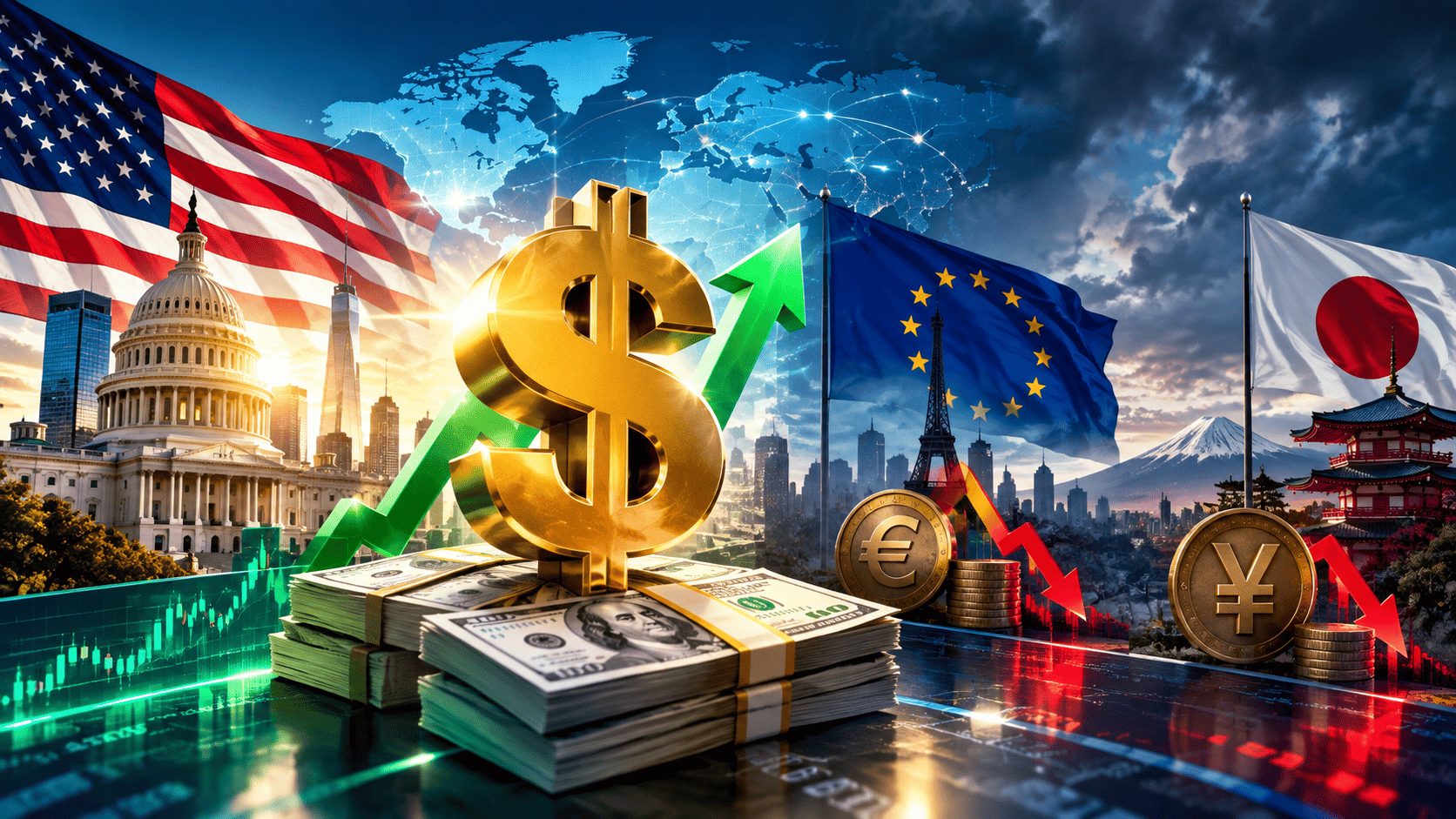
The U.S. dollar is making a powerful comeback in global currency markets.
After a volatile year for currencies, September 2026 has brought a notable shift: the dollar has strengthened sharply against several major currencies, particularly the euro. Reuters reported on September 30 that the dollar was near its yearly high against the euro and was on track for its biggest monthly gain against the euro in 14 months. The euro had fallen to around $1.1312, its weakest level against the dollar since May 2025.
Table of Contents
- Why Is the U.S. Dollar Rising in 2026?
- The U.S. Economy Is Creating a Currency Advantage
- Why Is the Euro Under Pressure?
- Is Europe Really “Struggling” While America Surges?
- What Is Happening to the Japanese Yen?
- Why Didn’t a Japanese Rate Hike Automatically Weaken the Dollar?
- The Dollar-Yield Connection Is Becoming More Important
- What Does a Stronger Dollar Mean for Global Investors?
- What Does the Dollar Surge Mean for Emerging Markets?
- Could a Strong Dollar Affect Gold and Oil?
- What Does the Dollar Surge Mean for U.S. Businesses?
- Could the Dollar Surge Continue Into Q4 2026?
- What Should Investors Watch Now?
- Why the Global Dollar Surge Matters for 2026 Markets
- Final Thoughts: Is the Dollar Entering a New Global Power Phase?
So, what is behind the global dollar surge 2026?
The answer is not simply one interest-rate decision. Investors are responding to a combination of U.S. economic strength, Treasury yields, inflation concerns, Federal Reserve policy, European energy pressures, political uncertainty and Japan’s complicated currency situation.
For businesses, investors and emerging markets, the dollar’s move could become one of the most important financial stories heading into the final quarter of 2026.
Why Is the U.S. Dollar Rising in 2026?
The biggest factor behind the latest dollar rally is the changing interest-rate outlook.
U.S. Treasury yields have climbed significantly. Federal Reserve data showed the 10-year Treasury yield at 5.18% on September 24, while the 30-year yield reached 5.47%.
Higher U.S. yields can make dollar-denominated assets more attractive to international investors because investors may receive higher returns from holding U.S. government debt and other dollar assets.
At the same time, markets have become more cautious about the future path of U.S. interest rates.
That combination is supporting the dollar.
Reuters reported on September 30 that the U.S. currency was being supported by stronger U.S. growth and rising interest rates, while Europe was facing energy and debt-related concerns.
The U.S. Economy Is Creating a Currency Advantage
Currency markets constantly compare economies.
When investors believe one economy can maintain stronger growth or higher interest rates than another, capital can move toward that country’s financial markets.
That dynamic is currently helping the dollar.
The latest market environment has produced a significant rise in U.S. yields, while investors continue to monitor inflation and employment data for clues about Federal Reserve policy.
This matters because a stronger U.S. economic outlook can support both U.S. stocks and the dollar, although the relationship can change quickly when interest-rate expectations shift.
Why Is the Euro Under Pressure?
The euro has become one of the biggest stories behind the current dollar rally.
Reuters reported that the euro fell to approximately $1.1312 on September 29, its lowest level since May 2025. The euro was around $1.1339 on September 30 and was down nearly 2.5% against the dollar during September.
Several factors are creating pressure.
1. European Energy Costs
Europe remains sensitive to energy prices because higher energy costs can raise inflation while simultaneously hurting household purchasing power and industrial activity.
Recent European gas prices surged to their highest levels since 2022, according to Reuters.
This creates a difficult policy environment for European policymakers.
2. European Debt Concerns
Investors are also watching government borrowing costs.
Reuters reported that the spread between French and German government bond yields had widened beyond 115 basis points, the largest gap since 2012, amid pressure surrounding French public finances and political uncertainty.
Higher borrowing costs can make fiscal challenges more difficult to manage.
3. Slower European Growth
The European Central Bank’s September projections put euro-area growth at 0.9% for 2026, compared with 1.4% in 2027 and 1.5% in 2028. The ECB also projected headline inflation at 3.0% in 2026.
That combination of relatively weak growth and persistent inflation makes the European economic outlook complicated.
Is Europe Really “Struggling” While America Surges?
This needs some nuance.
Europe is not simply experiencing an economic collapse.
The ECB raised its three key interest rates by 25 basis points in September, taking its deposit facility rate to 2.50%. The central bank said inflation pressures remained elevated and highlighted uncertainty surrounding the energy shock.
The more important issue for currency markets is relative performance.
Currencies are traded against each other.
Therefore, the dollar can rise even without extraordinary U.S. growth if investors become more concerned about the outlook elsewhere.
That is an important distinction behind the global dollar surge 2026.
What Is Happening to the Japanese Yen?
Japan’s currency story is even more complicated.
The Bank of Japan raised its policy rate to 1.25% in September, the highest level in 31 years. However, the move initially failed to produce a sustained yen rally because investors questioned how aggressively the BOJ would continue tightening policy.
The yen has also been affected by concerns about imported inflation.
A weaker yen increases the cost of imported commodities, including energy.
Japan has therefore been trying to balance two competing objectives:
- Controlling inflation
- Preventing excessive yen weakness
- Avoiding an unnecessarily sharp economic slowdown
- Gradually moving away from decades of ultra-low interest rates
Japanese officials have also warned markets about excessive yen movements. Reuters reported on September 28 that Japan’s top currency diplomat reiterated that Tokyo and Washington had delivered a clear message regarding the yen and declined to rule on future intervention.
Why Didn’t a Japanese Rate Hike Automatically Weaken the Dollar?
Normally, higher Japanese interest rates could make the yen more attractive.
But currencies depend on expectations, not simply on the current interest rate.
Investors want to know:
Will Japan continue raising rates quickly enough to close the gap with U.S. rates?
That question remains important.
Reuters reported that two BOJ policymakers dissented around the September decision, contributing to uncertainty about the pace of future tightening.
As a result, the yen can remain under pressure even while Japan is raising rates.
The Dollar-Yield Connection Is Becoming More Important
One of the most important themes for investors is the relationship between the dollar and U.S. Treasury yields.
When Treasury yields rise, global investors may have a stronger incentive to hold dollar assets.
This can create a feedback effect:
Higher U.S. yields → stronger demand for dollar assets → stronger dollar → pressure on other currencies
However, this relationship is not guaranteed.
If higher yields are caused by concerns about U.S. fiscal sustainability or inflation, markets can react differently.
That is why investors are watching both the level of Treasury yields and the reason behind the increase.
What Does a Stronger Dollar Mean for Global Investors?
A stronger dollar creates winners and losers across the global economy.
For U.S. investors, a stronger currency can reduce the dollar value of foreign investments when those returns are converted back into dollars.
For international investors, however, U.S. assets can become more attractive if currency gains are added to investment returns.
This makes the dollar particularly important for global portfolios.
What Does the Dollar Surge Mean for Emerging Markets?
Emerging markets can feel the dollar’s strength quickly.
Many emerging-market companies and governments have financial obligations linked to the U.S. dollar.
When the dollar becomes more expensive relative to local currencies:
- Dollar-denominated debt can become harder to service.
- Imported goods can become more expensive.
- Inflationary pressure can increase.
- Central banks may face pressure to maintain higher interest rates.
- Foreign capital flows can become more volatile.
This is why the dollar’s movement matters far beyond the United States and Europe.
Could a Strong Dollar Affect Gold and Oil?
Yes.
The dollar and commodity markets are closely connected.
Many globally traded commodities are priced in U.S. dollars. Therefore, a stronger dollar can influence the purchasing power of international buyers.
Gold is especially interesting because it can respond to several forces at once.
A stronger dollar can create pressure on gold because gold becomes more expensive for buyers using other currencies.
However, geopolitical uncertainty, inflation concerns and demand for safe-haven assets can provide support.
That means gold and the dollar do not always move in opposite directions.
What Does the Dollar Surge Mean for U.S. Businesses?
A stronger dollar can have mixed effects on American companies.
Companies that import goods or raw materials may benefit from cheaper foreign inputs when translated into dollars.
However, American companies generating significant revenue overseas can face a currency translation headwind.
For example, if a U.S. company earns €100 million in Europe, a stronger dollar means those euro revenues convert into fewer U.S. dollars.
This can affect reported revenue and earnings.
Therefore, investors watching major multinational companies need to pay attention to foreign-exchange effects in earnings reports.
Could the Dollar Surge Continue Into Q4 2026?
That depends heavily on incoming economic data.
Reuters reported on September 30 that markets were watching U.S. core PCE inflation and employment data for clues about the Federal Reserve’s next moves. Comments from New York Fed President John Williams had also reduced some expectations for another immediate rate hike.
This creates an important test for the dollar.
If U.S. economic data remains strong while inflation stays elevated, markets could continue to price relatively high U.S. interest rates.
If U.S. growth weakens or inflation falls significantly, expectations could change.
Therefore, the next major dollar move may depend less on today’s headline and more on the next round of U.S. economic data.
What Should Investors Watch Now?
For the final months of 2026, several indicators could become especially important:
- U.S. employment data — A strong labor market could influence expectations for Federal Reserve policy.
- U.S. core inflation — Persistent inflation could keep interest rates higher for longer.
- 10-year Treasury yield — Rising yields can influence global capital flows.
- EUR/USD — This remains one of the clearest indicators of the dollar’s strength against the euro.
- USD/JPY — Investors are watching both BOJ policy and possible Japanese currency intervention.
- European energy prices — Higher energy costs could affect inflation and growth.
- Global bond markets — Rising yields worldwide could change the relative attractiveness of different currencies and assets.
- Central-bank policy — The Fed, ECB and BOJ remain central to the currency story.
Why the Global Dollar Surge Matters for 2026 Markets
The current dollar rally is more than a foreign-exchange story.
It connects several major themes shaping global finance:
Interest rates + Treasury yields + inflation + energy prices + economic growth + government debt + central-bank policy.
That is why investors are paying close attention to the dollar as September comes to an end.
The U.S. dollar’s September strength has coincided with a difficult environment for the euro and continued uncertainty surrounding the yen. At the same time, the Federal Reserve’s policy outlook remains highly dependent on incoming inflation and employment data.
Final Thoughts: Is the Dollar Entering a New Global Power Phase?
The global dollar surge 2026 shows how quickly currency markets can change when interest-rate expectations, economic growth and geopolitical risks move in the same direction.
The dollar is currently benefiting from relatively strong U.S. economic momentum and elevated U.S. interest rates, while Europe is dealing with energy and fiscal concerns and Japan is navigating inflation, currency intervention risks and a gradual shift away from ultra-low rates.
But currency trends can reverse.
The next major test will be whether U.S. economic data continues to support elevated interest-rate expectations while Europe and Japan manage their inflation and growth challenges.
For global investors, one message is becoming increasingly important:
When the dollar moves, global markets move with it.

References


